Showing posts with label The Arms. Show all posts

Friday, January 22, 2010

A Sense of Déjà Vu at the Buttes Chaumont by The London Archaeologist


One of the perks of being back in at least semi-employment is the conference round. My last was to be hosted by the Société du Vieux Paris, or Old Paris Society. They invite me out every few years, and I'll always one way or another have someone from the society over here to talk in whatever institution I've worked for. This isn't back scratching. London and Paris, like all cities, for reasons both obvious and obscure, are intimately linked - more than many, and now of course with the tunnel, they have become extensions of each other's tube systems.

This isn't a work-related blog, thankfully, or there wouldn't be much to report, however. As a result of the wrong kind of snow falling on the train, I missed the conference. Instead I went out after it for two spare days just before Christmas.

The relationship of the twin cities is reflected in my own personal history. I spent time in the French capital before my University degree, during a brief flirtation with the idea of studies there. I know no one there any longer, apart from vague acquaintances associated more or less with the Société. All my visits are coloured by a sense of familiarity not only with the architecture and apects of the archaeology, but also, I now feel, with this familiarity's being that of someone increasingly distant from me now. However, whether this feeling is itself something that's genuinely grown over the years, or is an illusion resulting from what's been something of a sudden jolt I received in this last trip, I can no longer say with any certainty.

The weather was dry, clear, but with the sun skulking, rarely summoning the energy to peer over rooftops. As I left the hotel on the first morning, near the intersection of Boulevard Voltaire with Rue de Charonne, it was with a sense of inner reflection, but on nothing of purpose. To say that I was expecting, for instance, an encounter with this person I might recognise, but would never become, would be to go further than I could be sure of. Certainly nothing concrete for the blog.

However, I now rarely move without a camera in one pocket, a notebook in another, and a pen somewhere about me, and not long after setting out I saw the first sign of work to be done: 'square' in its planning sense is a word I've long been meaning to work on in the London context. Seeing it here in Paris shook me suddenly from my complacency. I had only a couple of days to see what they make, there, of the urban form, and what that might shed on their etymological source in London.

The result was in equal proportion illuminating and perplexing. The word, then, could be taken not only to have no relation to shape, but to require no terraced houses or perimeter road around it. This one was only accessible from barely noticeable passageways.

Taking my map from my pocket, I hunted down the nearest other to direct my steps that way. Much more like the English, 'Square Bolivar', despite the name, and though still alien enough to be of interest. Something would surely come of this. Lunch in a nearby café would be an opportunity to plot a route taking in further squares, with which to get to the essence of the shape as it appears through the tunnel.

The streets I tried abounded in cheap North African places whose menus, when they extend beyond merguez sandwiches, tended towards couscous. If I was going to try to grasp the sense of the local urban space, perhaps this would be a distraction. If I was to mine linguistic differences, perhaps I should immerse the tongue itself, eat French. Passing a park, I reasoned that something posher might be found in its perimeter. Serving a more bourgeois bunch, a trad. menu might be found there. Passing the Kaskad, given something in the spelling, my first expectation was of disappointment. In fact, the menu was fairly traditional. I took out my writing implements and waited for an Andouillette (sausage of 'boyaux', the waiter had informed me - narrow pipes, passages, tubes - and, seeing my perplexity, indicated the systems of his stomach), congratulating myself on my savvy deduction.

The wine, when it came, suggested, too, the advantages of my food policy, and looking to my left out of the window, I leant comfortably back in my seat. 'Cascade', of course, I realised, seeing the high mound of a park, topped by a little belvedere, and feeling my skin prickle.

On that first day coming out there, as I was searching in the chaos for a way out of Eurostar's insane mismanagement, I'd become aware of a beaming smile fixing me from the crowd. The man was both genial and intelligent. He too had been visiting Paris for some sort of conference, insisted we exchange cards. Although my memory was foggy, the man had a knowledge of my background - university life, my studies, of course, the Windowless Consultant, even, the Landless Landlord and events at the Arms - proving we'd once been closely acquainted. Insisting we go for a drink, he immersed me in anecdotes in which I figured, but had quite forgotten.


Amongst these, he kept on insisting that I'd spent an evening engrossing him in accounts of books I'd read in my gap year, out in France. In attempt to jog my memory, he went into such detail about them that I was entirely hooked - by what he told me not just about the texts, but also about the reasons I'd given him for my interest. It's all a bit vague now, a conversation shouted over the noise of the crowd and too many beers in the station 'pub', if our own Landless Landlord will excuse the term for a place that, despite what looks to me like a good beer policy, has, all told, a slightly tasteless cocktail air to it. And yet here was undoubtedly one of the locations. He'd shown me the map he'd been taking to Paris, now, finally, with the intention of following up my recommendations. There, beyond question, was a handwriting which, with allowance for change over the years, was to be recognised as my own. The map was mine, he insisted, had somehow got mixed up with his stuff in one of our drunken conversations all those years previously, now I must have it back so there I was with it in the Kaskad. Much of the writing was illegible, but two words were still quite clear: 'belvedere' and, alongside it, the more ominous 'suicide bridge'.

What I know of the book now's thanks to what he told me of what I'd told him all those years before, a walk around the place at night, philosophical reflections, a mixture of fact and fiction, sections, he said, down to chance.

The landscape the man described, though he claimed to know of it only from my account, was undoubtedly the same, the belvedere itself, on its high mound, accessible via the two bridges, one fenced around to stop the suicides; the other mounds; lakes; even an urban light railway, down there deep in sidings, now disused.

And yet, the more that his story was confirmed by the topography, the more irritated I became. The events were so long ago. I did feel I recognised this place. But that only made things worse still, since I couldn't be sure my recognition wasn't itself a result of my having visualised the minute description which, though he attributed it to me, I couldn't be sure wasn't his own. Now I thought about it, perhaps I hadn't deduced the presence of the Kaskad at all, as I'd flattered myself, but had remembered it, if not from a visit of my own, years ago, some reference in his account. As for the text, if he couldn’t recall the name, or even the writer, how could I know they were even real?

Obviously my interest in the squares project diminished. Instead, I rifled through the map for further annotations, places to test further my recollection.

Saturday, October 10, 2009

No Sign of Albert by the Landless Landlord.


To identify where the signs are going, it was about time I addressed what they do. While it would be absurd to say that the sign is the name, nor do they just illustrate it, since the name - the Carpenter's Arms, the Dog and Whistle - clearly follows the image, not the other way round. But, since nor does the fact they should be attractive, of course, mean that they only adorn, or that they're noticeable exhaust their purpose in the beacon, I realised that the function for me, after all these (those?) years in the industry, remained a mystery. There is the pub, there is the name, there is the sign, but to sense suddenly in the repetition profligacy, the sign, for instance, an unnecessary addition, would have been to side with their reduction - names, signs, pubs - and by fifty-two a week according to the most estimable estimates. They form a trinity, mutually dependent facets, but each to be admired in itself. At the same time, I had no explanation for why, and for justification sought more examples.


After the Angel, where the name proliferates but the sign is long gone, it seemed to me wise next to consider the opposite scenario. A good example was sure to be the Albert, since there we have the manifold signs for the one name - with Arms or Head appended, the Royal or the Prince.


Since I live East, I picked a couple to visit on the way in towards town by means of a Googlemaps app.. First stop, though, Elia Street, off City Road, the Prince, already was erroneous. Here was no Albert, but an essayist in profile view, the city he presumably loved, lived in, described, addressed, some instruments of his work, and samples in quotation. The nature of this one, hovering, wavering between image as picture and as word, perhaps this might tell me something about the demise of the hostelry tag as medium, but also its fight for survival. The words after all were not image as word but word as image of word, the notebook not a notebook but an outline of a notebook, there to denote the man, the pub sign still a pub sign then, not a description or a name tag hung on a wall. The essayist being one of life's loggers, that here he was doing whatever it is pub signs do and that I must discover seemed in itself noteworthy, and although I'd thought at first my research had been fluffed to have led me here, all was not lost if a lesson was to be learnt. A pub sign could be a kind of protoblog, seemed to be the message, or perhaps even, I wondered, with a mixture of excitement and remorse, a blog a pub sign, a part of their disappearance or a hand in their renewal.

Next stop was a house of the same name on Acton Street, where I understood what had been - and what an extremely useful site, a kind giving not pub but ex-pub addresses, a kind of anti-fancyapint, or fancyapint of the departed, has since proved to have been - the source of my previous disappointment, too: not a googlemap error, but a result of change of use, the earlier to the Lamb, this place now to from Prince Albert proper to Konstam at the Prince Albert. Inside, instead of taps, the offensive sight of coffee and wine, tables all with napkins folded into glasses, not a beer mat in sight. I like coffee very much and love wine, but at the expense of beer, in the Konstam, they were agents in the demise of the Prince Albert. An accompanying agent, of course, was the removal of the hanging sign, featuring, as must be presumed, its representation of the royal - no mere ornament, then, signs, but an intrinsic part of what the hostelry is, which, for the hostelry to move on, must go.


The only other Albert I recalled, to continue on my trail, was in Kensington. The fact that this one was no pub sign at all was an important part of why, I sensed, I had to go there.


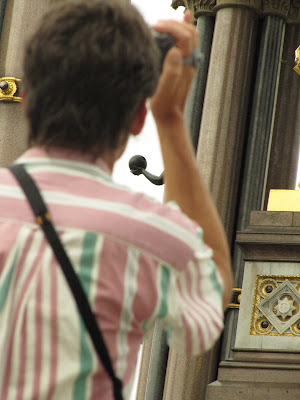
But the result was unexpected, so clear it was impossible not to suspect causality. Everywhere in the city, on the signs, his portrait disappearing and with it even the name, and then here, at the centre, the opposite, the portrait incessantly reproduced, cameras from all over, not just London, but the world, descending on the area, filling the air with their clicks, noisy, barely perceptible, or, equally, silent. And the sculpture was pre-figuring the actions of the photographers. Dictating. The urge to photograph was automatic, unconscious, it would seem, irresistible. In some way the idea was to suck the outskirts dry, the centre becoming increasingly dense, repetition not only of the act of photography, but also, and reflecting the repetition of the picture a photograph takes of a scene, the image the photographer makes of the seen, their gestures those of the stones. Here the air became a crystal medium, movement jagged and interrupted, ritualistic. I had not understood until now. This, then, was why I, too, had come in search of Albert, felt my own arm rise, camera in hand. Deflecting the force from the statue, perhaps I could at least focus, not on the sucking centre, but on his reflections everywhere abounding, multiplying off each other, each passer by a facet, of the crystallized spirit of the man - appropriate the power for myself.


This was not the chaos of Borough, clearly, though at the ordering system for now I couldn't guess, just record, work it out later. The repetition was kaleidoscopic, one photographer going, another arriving appearing to disappear and reappear, the same, but different, reflections of each other, themselves, the stones, folded into and out of the revolving facets of the very air. This man, for instance, who seems to be taking a photograph of this woman reading, reproducing the man reading behind her, the stone looking back at her with the force he's tapped of her life. No, who's looking at me, this man, photographing him, who's a man I've seen before, a man I know, knew. The man who's come to be known as the Archaeologist, I find, and who, as me, as though we'd never lost contact, had always had this rendezvous, had been drawn there to the memorial in search of material for a - this, it will turn out to be - blog.


From here on detailed account is superfluous, since it's been made before in the blog that this one is now itself joining, but I feel perhaps some reduplication is nevertheless necessary for a sense of completion and unity within the post, to express our surprise, for instance, as we did, at seeing each other there, and how little we'd changed since the university years, how we wouldn't perhaps have recognised each other, though, still, after so many years, the way you don't, unless we'd started thinking about each other recently, something about having lost our jobs, thinking back to before, our university days - his when he was at it, mine when I was near.


I feel I've been approaching something in these posts, the experience at the monument the nearest, but I don't know if I could arrive at it alone. It's for that reason that I agreed to join forces with someone from a so distant past so propitiously met. I don't quite get his reasons, but the compulsion was contagious, and that he feels we share a search is promising. Since, in fact, loosing the steady work, I've been mentioning the man increasingly, in these posts, and his girlfriend, or rather, since I no longer knew him, the student that he was, the girlfriend she then was. It's almost as though it was them that I'd been looking for, though of course, not least since, having now found them I feel renewed vigour in the search, that can't be the case, that would seem to be a red herring of some sort.


This, then, my first post with the archaeologist and the consultant, the last on Pubsignstakenforwonders, where I've packed the bags into a bundle to unpack them integrally on The London Archaeologist and the Windowless Consultant, tying my dates in with theirs, but maintaining my own label down the side.


Sunday, October 4, 2009

Seen Outside a Public House, Asked to Account for his Actions by the Landless Landlord


I was wondering who was the Angel of Angel. The inn, we know, that gave its name to the area, stood near where the tube now is. There was a sign, certainly, identifying the spiritual form in question, whether Gabriel, Raphael, perhaps as represented on the coin, or someone now unguessable: no known images remain.

In Highgate there's a pub by the name with a cast of the Victory of Samosthrace over the door, promoted to angelhood by, what, chance, some landlord picking the thing up in a boot sale and finding it fine over the door? That's how the signs work, I'm beginning to think, the words and the images slipping over, under, round each other, things being named and names being shown not once and for all, but as a process. That's what I should be trying to capture, then. At Angel, I thought, perhaps I could - something underway.


The local bookshop, 'local interest', has much to say. The process is the same at other locations on the outskirts of the early city - Elephant and Castle, for instance, and I, for one, suspect Pimlico: a coaching inn names an isolated crossroads, makes a stop out from town, and, when the city eventually grows to meet it, the built-up area as a whole. When the inn disappears, though, as at Islington, and the name names a spiritual being, it wanders, attaching itself to all sorts of other things, forlorn, gleeful, desperate, melancholy, abused and opportunistic by turns, pub without a sign, sign without a pub, tube hole, shopping centre public sculpture, Business Initiative District, unnoticed collective potential, co-opted, conscripting, squatting or worn.


I was beginning to uncover the Angel in the space, often unknown, frequently avowed: Diana by the toilets, angelicized for the Angelic. The process, then, of angelicization, bring it into the ambit of where the old pub's named a new. Venus on the bar itself. This one had nearly flown when a pissed punter had attempted to run off with her, I was told on investigation, presumably stricken with Pygmalion love, the plaster lump being of no great value, grabbing it from the bar and running, but, born down by weight, had been easily disburdened, brought round to his senses, sent home to sleep it off.

The area names a business and celestial lore is practice here on earth.

In things, but also in people. I had no idea what this might mean. Was the angel a product of the camera, or rather, without the camera, would it be freer, more ubiquitous, even if even less noticed still?


Can I photograph the space without me, without the camera to see, the florist, would that be the Angel? The questions were idle, pre-philosophical, they might have said, I recalled, my student days - the days I worked the students' pumps, Mile End, their reading groups, developed a taste for drunken philosophy that's perhaps never quite gone away, repeating on me now so many years later I find myself behind them in the dole queue. The woman, what was her name, offering design tips on the pub? What would she be doing now? Could we ever have hit it off? That had been his thought he'd put to her - mine back then -, she'd smiled but seemed offended. Mere pump puller, me a student, worlds apart?

I'd warned the florist I'd be slow, and this certainly was that, what's more, a new camera with more controls to fiddle about with - opening aperture to blur up foreground drinkers - no permission from them, don't want anything recognisable as the shot passes up past them, takes in their fuzzy profile, details untouched.

'May I ask what you're doing?' Man in a mock cop uniform, 'Community Police'.

If you don't know, how can you say? I believe this man selling flowers may be the Angel, one of the angels, the sign gone, the word still there. I'd asked, he'd said yes, but then, if they spoke, the angels, would I understand?

'But you were focusing on the drinkers.'

No, no, the Angel, the drinkers a blur. Though they may too be angels, I don't know, didn't ask.

'How do I know you only included only the florist? How do I know there aren't strangers there too? Can I see?'

Can a man in his position see an angel? I thought not. If I'd had the chance of capturing one, would it remain in the camera as I passed it to him? There wasn't of course a law against photographing angels, and, if there was never to be one, my duty was to decline.

'Have you heard of Section 44?' I blanked. It rang bells, but the context threw me. 'Prevention of terrorism'. Failure to comply - to hand over the angel - would mean he'd call the real police, the ones he aspired to be. If I just only said yes he'd have a look and go. If I said yes, to be seen hunting angels on the street is reasonable grounds for suspicion of plotting a terrorist act, he'd let me go. Could I, then, too, be an angel, trapped, wing stuck in the works, or should I hand over? The answer was clear, but hard to put across. It would be colluding with terror, siding against the angels, to hand over my camera to this man.

A van, six or eight people in case I was dangerous, the

photographer of florists. Conflicting stories. Was I crouching dangerously behind a bush, as the man said, or was it rather what you call low angle? Was this about photographing strangers or could it be plotting to bomb? Was the officer trying to blur difference? Why? Was he, perhaps, the revenging angel, was it how you saw it, crouching, the depending angle?

As I left, slightly shaken, one of the drinkers waved me over. What had happened? Was it for the photograph? Did I have consent from the flower man and what had I said? This punter, too had been stopped, a filmmaker - fiction -, and on the next table a fashion photographer knew a man who had. In fact, returning home, I find the experience is common, with a lot of chat about it (my own encounter I added in a relatively early comment to Porter's site on the day, before the later chat made it apparent just how far it was from unique) and an international protest grown since (the events reported in this post actually dating from some while ago) to something really quite big.

So perhaps I have to rethink my previous entry, the number of photographs killing the pub signs, the pubs dying with them, the photographs taking over. I need to put on my thinking cap, back to the student days, start all over, decide what it is, a pub sign, but also a photograph. The assumption that to take one's a free act, the space independent of the photograph, you clutch, squeeze, go unnoticed, false. The Angel is the passer by if you crouch, but a Business Initiative District if you're caught, a public space in the imagination, in reality, an area given over by the council as an experiment, an image of the public space imaginary. In the one space the blogging photographer captures angels, in the other he plots bombs, in the imagination, a law to catch terrorists would be a law to catch terrorists, in reality, it nearly let angels escape.