Almost every time I come out of a brown study, I am struck by the etymology. Colours, we know from the linguists, are, in the growth of a language, only slowly differentiated, and the order of their appearance is physiologically determined by the nature of the eye. The bright and primaries come early and the murky mixes late, after adumbrating only the broadest distinctions in shade: light and its opposite, dark, to which 'brown' without chromatic precision originally referred. And it's from that time that the expression concerning inwardness comes down to us. The literal term having taken on colour, though, the expression now always seems slightly unaccountable, and as I emerge from reverie, it is frequently into renewed surprise that what had felt only like a distant inner shade should be given such a precise character of tone, but then I recall that the sepia tints adhere in the present sense alone, the term for the journey inward having originally had a logic that, emerging in the present, becomes blurred.
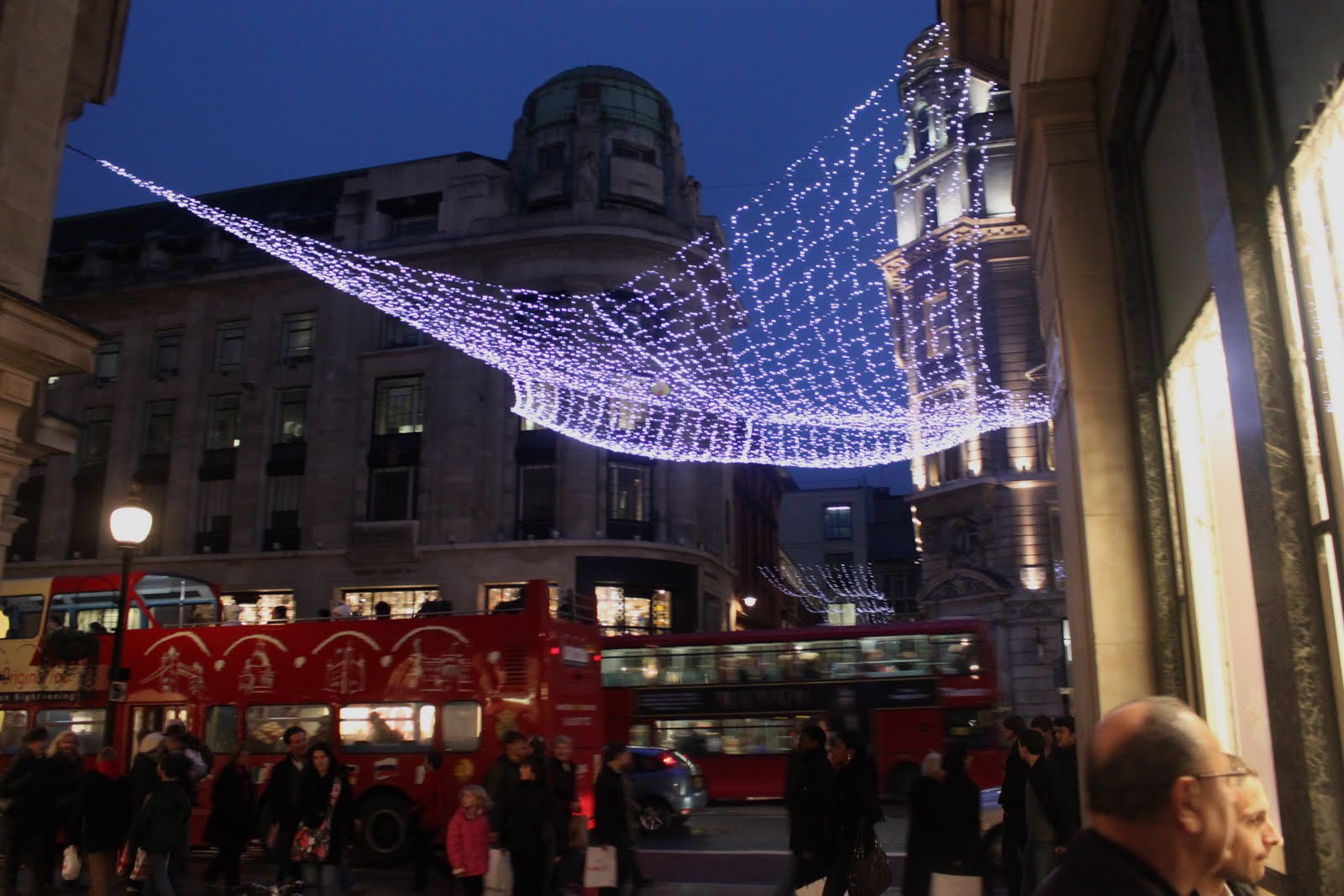
A recent time was on Charing Cross Road. I was standing outside Border's thinking about nothing special, looking at nothing in particular. A bus had pulled up, stopped at lights. Absently, I read. Border's, sex shop, arrows pointed downstairs in the doorway. At first I thought nothing of it. Soho is a place of fronts. Soho Books, for instance, with its apparently innocent entrances to artish bookshops hiding steps down to porn in the basement. 'Soho' there means porn, just as it means art, the one, it suggests, a front for the other. But Border's, it slowly dawned on me, was not a bookshop of the sort. It was, for a start, on the wrong side of Charing Cross Road. St Giles, more accurately than Soho. Looking back at the shop to check, I confirmed: no sign.
For a minute I believed I must have dredged the image up from some unguessed associations in my inwardness, and, at the same time troubled, interested and amused, raised my eyebrows, shook my head, and was soon again engrossed in nothing. However, not long into this, something in the colours and shapes before me reminded me again of what I had seen before. Looking up, there it was in the window of a bus, again waiting at the lights.
It would have been easy to dismiss this as illusion, and in many ways of course it was: the licensed sex shop in the basement of Border's would illude, as the etymology for the fictional image is, any attempt to visit it by simply entering through the door. And yet, to have stopped there, accepted that there was no other Border's, perhaps visitable by others than ourselves, would have been to reject the discoveries at the heart of this blog as a whole, to regress, wilfully to forget: to hide. My very presence on the outskirts of Soho, indeed, since I had gone in search of such signs, would have been inexplicable.

I've been, from the very first post, seeking out the presences, characters, lives that go unrecognised even – indeed mostly - by they themselves that live them, are them. That the inhabitant of slower times, the fascinated statue, those on the line to the eye hospital all go unremarked is what qualified them for entry. I have always known, too, the role of the camera in capturing what might otherwise pass itself off as belonging in a more ordinary way to the world.

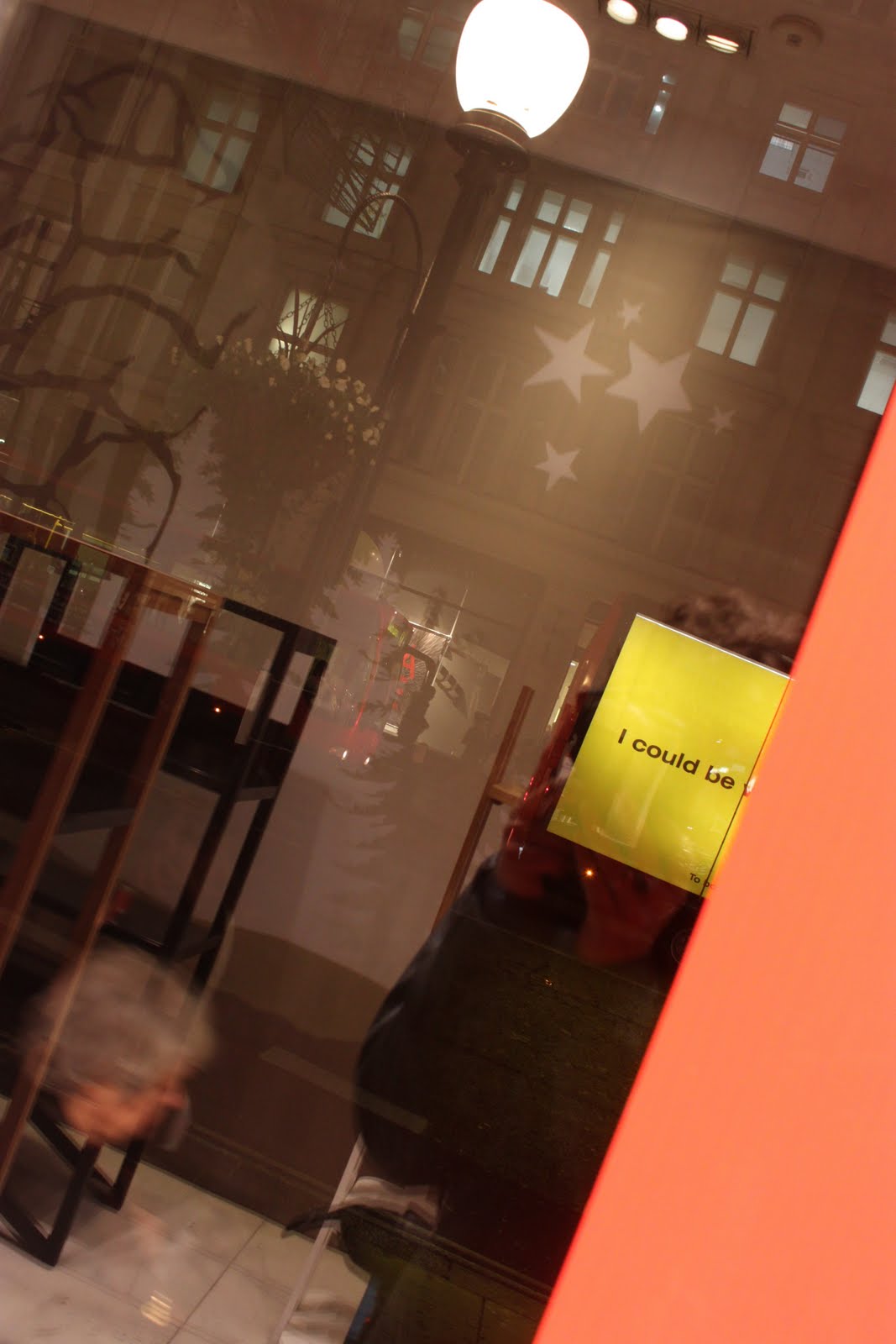
Something that I have come to understand during this process is that the events, situations and spaces revealed in partial reflection on glass are a central part of this unrecognised world. Generally ignored as illusion, they capture realities otherwise concealed. It is through the senses that we construct our world. If your senses tell you that a tiny couple is sitting round a little table on a bar in Marlborough Street, in the shade of cocktail parasols dwarved by the bottles; that a man stares baffled in a hard hat at images of London on a steak house wall; that an artist's wooden manikin has grown, the street reduced, to walk among surprised pedestrians, to doubt them is, accusing the sole medium by which it is perceived of invention, to doubt the world itself. Indeed, if these images disappear as the light changes, when you step back or draw close, if the space crumbles when you move a fraction up or down or on the passing of a cloud, that only suggests that they are not less, but, more fragile, more valuable, so much more urgently to be hunted out, captured and contemplated in an attempt to learn as much as possible about what world or worlds it is these fleeting glimpses illuminate, what lives their denizens lead, what trials and triumphs are theirs and whether we might share in them.


Certainly their space has many features in common with ours, and, no less variegated, its atmospheric modulations themselves reflect our own.

If antique sculptures, for instance, come alive on City Road, and fireplaces appear in the street, if puddles hold woods of silver trees on Old Street, viaducts houses, houses cranes in Islington, in Soho one would expect - one gets - quite other things.
Soho, we know, goes back for its name to a hunting cry. My own suspicion is that this itself was a contraction of 'Southward ho!'. For the street plan we have farming strips which, bought up for development lot by lot, create the tight network easy to get lost in and hard to cross east/west - a place imposing a change of direction, then, on those in search of game, an imposition finding its way into the name.

It is a place that has always resisted efforts to tame it. The developers of Mayfair, for instance, could only think of containment - that Regent's Street has ever since formed a clear cut strip to stop the atmosphere spreading west has helped not only to prevent the neighbouring areas from absorbing its wanton atmosphere, but Soho itself from loosing it. It was here that De Quincey came for opium, found and lost a love and, wandering in search of her, feverish on laudanum, by fits and turns his mind; here that the anarchist Verloc in his sex shop plotted to bomb the Observatory on the Meridian line. That the zero point, pure abstraction, was by its nature unassailable might have warned him that what his explosives found there would be none other than his own envoy, letting it off in his face. That it did not is perhaps a gage of the extent to which the Empire's to Soho's space was alien. It was to Soho that the Huguenots came, wandering, stateless, progressive, of the forces that would topple the king, alluring, mistrusted. Long Bohemian, it was always destined to become at some point an artists' centre, too, and, though it took till the 1950's for painters to catch up and embrace it, since then they've never let go, the creative industries as a whole, and the services that service them - moving in on a permanent basis and somehow managing, not only not to suck the life from it, but to contribute to its life, not only not to the camera shops, couriers and cabs, the cutters and the runners, the boozers and cafs all benefitting from a bustle almost industrial, as Soho, in order reduce the rest of the world into image, must maintain all the clunk, click and whir of the machine required to do it.

It was the area, too, that became the focus of Snow's great nineteenth-century study of the causes of the cholera ravishing the city. Said by some to result from the proximity of plague pits and others the thirst for immorality, Snow revealed that the disease in fact followed patterns of consumption, the potion of transformation water from public wells. Finally, distilling all these other characteristics, it was here that Dr Jeckyll chose to lodge for his own experiments with consumption and destruction, disease and cure, drugs, desire and murder, all in the service of a dark experimental art veering into the most lurid low-brow. A building with a concealed back door, from one angle respectable and another corrupt, only one visible at a time, it reflected what he saw in the mirror: impossible but real, one thing by turns one thing and another.

To anthropomorphose geography, if the North's the head and West is best, East is left, which leaves the South: tufts, folds, poles and posts, a little mound, a place for hunting, a struck boar, place of game. The camera in my hands is a tool less of fixing than of groping out, finding. Directed at a window, the parameters that decide what it will see where, in relation to what, seem wild. Seeing becomes a series of bright flashes illuminating an obscure landscape.

In Soho, the windows tell me, a shop sells not birds of prey, but the experience of becoming a bird of prey, stuffed, behind glass, but alert, hands in pockets, human, determined, walking on by. As a man turns around from browsing record covers his head swivels onto the shoulders of a strip club spectator from the fifties. Whatever it is I'm looking for, I grope, vicarious claws in it, human or animal, viscous, feel it move. Another flash and a faceless woman with folds of cloth lifts images from passers by. Soho, a place of sweating, of insights to come, where fever, drugs redundant, brings water with death in bed.


That from a brown study here, a reverie of the sort that I had been having, should emerge the vision that I had had, of an innocent-looking bookshop harbouring a special entrance dependent on the passing of a bus was too appropriate to dismiss.

Having photographed that too, I began to cross the road to see what else I might make of the corner by the window of the Soho Books branch responsible for its part of the entrance, when I saw someone there, bending down, photographing.
Something, I don't know what, made me guess that she was photographing not the contents of the window but me in reflection. Under the circumstances of my own search, this was both exciting and unsettling, but I continued to cross. As I did so, the woman bent up, and something in her movements that I recognised, as it trumped the previous coincidence with another, made her presence there seem as natural as if we had an appointment: as the one that I've been calling Jessica, when we had separated, was a trained window dresser, recording the contents of a window was exactly how I should have expected to see her, and our conversation proceeded in certain ways as naturally as though our last conversation, instead of years previously, had occured perhaps only that morning to set up the afternoon's rendezvous.
In certain ways, that was perhaps a result of the social ease that Jessica had always had, and which had since the first attracted me to her, even as I had found it slightly threatening. But then, her ease with me had, I seemed to recall, ceased to make itself felt as our relationship had begun to sour. The time apart, it seemed, had mellowed us both, and it was with genuine pleasure that I accepted the business card, as I thought it was, that she offered me; not necessarily for the prospect of seeing her again, but as a genuine expression of an interest in our associating once more.
That was a couple of weeks back now. I chose not to post about it at the time for two reasons: firstly, because the job was not finished - I was still hunting down reflections - but secondly, I had not pursued the anomalies on her card, not thought of investigating a blog which it had been my assumption was one of the sort that, in the years since our separation, I had heard on the grapevine she was having a certain success with: some sort of window dressing tips thing for retailers. But at some point I did look closely, and realised that it did not seem to be that at all, looked it up and confirmed.

The parallels with my own blog I will leave for the reader to uncover, their significance to time, but that parallels there are, it must be acknowledged. To make it easier, though, for these to emerge, we have decided to blog together. This is not without precedent in the blogosphere. It was the Windowless Consultant, as I shall now call her who I have previously here called Jessica, who suggested this, and emailed me a link in example.