

I'm now ready to write up my second day in Paris.


The main task was to explore another of the heavily the annotated areas of the map the King's Cross man claimed had been mine, concerning a guide book whose content may be of particular relevance to this blog. The Little Guide of the XVth Arrondissement for the Use of Phantoms has, it transpires, received interesting blog treatment elsewhere, allowing me to confirm the man's account. The guide describes a certain kind of building unaccountably common in that one little area of Paris - the wedge-shaped slice sometimes encountered here in London as a result, particularly, of the course of railways sliced through terrace backs. Their inhabitants, the man explained, are said to be in some way determined by the nature of the buildings. In fact, he said, a grin forming across features otherwise slightly liquid, as I recall, or absent, perhaps from the effect of drink, during his research into the shape the writer finds that these elusive beings include he himself, only now recognising himself, attracted to investigate by obscurer forces than curiosity alone, at last coming to understand that what he's seen as his life's been some kind of illusion, the memories making up his past unreal.

During breakfast, I flicked though the map to plot an itinerary for the day that would take it in, but also allow for research into my other interest in the city - the sense of the French 'square'.


The nearest to my hotel, I noticed with surprise, was that landmark piece of urbanism I'd always known as the famous 'Place des Vosges'. Formerly 'Place Royale', according to the map it was also to be known as 'Sq Louis XIII'.


I'm still working on the question of the London Square. I began last summer, in Hanover Square, where I hoped to establish the effects of geometry on behaviour, but the project remained unfinished. Expect further reports, though I can't say when.


The very term 'square' in its application has obscure roots and entangled branches. A key stage in the development of its form in London was at Covent Garden, where it took on the name, of course, of Piazza to suggest the Italian influence of the buildings lining it and the Palladian purity of plan. The design of the form there, what's more, warrants the individuality of its name. As is again visible now in post-modern souvenir, the mixture of red brick with stone details, and, more still, the open arcades lining its terraces, were continental influences that were to be dropped from what would soon come to be known as the 'square': an open space surrounded by terraced housing as focus for a unified urban development. Inigo Jones visited the Place Royale before designing Covent Garden. Having been an influence on the form, that it was later to borrow back for a name suggested that, when analysing even such a specific entity as our local London square, peering into the behaviours it produces, as is my plan, considerations of its wandering - indeed rambling - abroad will always be à propos.


'Square' in French, according to fr.Wikipedia, is a legal term, brought into use under Haussman, describing only the central open space, not what we would think of as the entire area - their place -, and thus not the address itself, either, hence the ability of the Place des Vosges to be simultaneously also the Square Louis XIII. Furthermore, being legal, the term is less descriptive of the form than ours, as noted of Menilmontant, and defines more the sort of activities allowed and required inside. This I take to confirm my suspicions about the secret relation of the English form to behaviour.


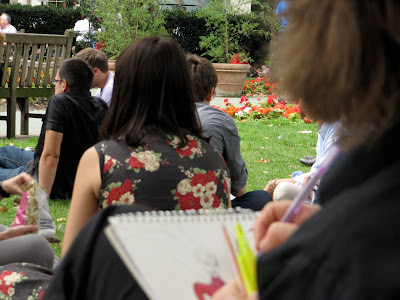
From my research in Hanover Square, I had at first been unable to determine whether these relations were a result of the shape of the square or that of the photographic frame. It seemed possible that the forms that appear result from the coincidence of the two.

In our Foyles Café discussions, the Landless Landlord informed me that Phoebe White's seminal Photography and the Obelisk contains a chapter suggesting that this works on the same principle as - is a form of - photography. The cloister, he suggested, was shown there to function as a camera obscura, cutting out the random noise of terrestrial life to retain only the focused spiritual forces coming directly from the sky. These would then be recorded in the form of the inner state of the monk, spiritual texts such as meditations, or pictorially as illuminations. The same might surely be said of the gymnasium of the ancients, antecedent of both the cloister and the square, the postures of the athletes, the peripatetic philosophies themselves direct representations of a higher cosmic order.


According to the Windlowless Consultant, Marks and Umbridge's Secret History of Photography, which she'd come upon several months earlier, had better claim to seminal status, and contained what she suggested was a more scientifically grounded hypothesis. She herself had proved on British Land Land before his encounter with his book that it was the influence of Daguerre's ramas that first unleashed the photographic potential of planned space.

I'm not convinced arguments about origins are helpful, or that the theories are incompatible. I do, however, suspect that at least one of the books may well have contained a chapter on the town square, arguing that it performs an equivalent function to the gymnasium or cloister. Passers by entering the camera obscura centre would, while obviously maintaining their usual identities, in some way become simultaneously units in a larger representation in exactly the same way that the individual silver crystals, dyes or phototransistors positioned at the back of the camera box maintain their identity as the substances they are, and yet also have a role in representing objects and events from beyond the shutter.

This was the hypothesis I sought to confirm as I stood in the Square St Jacques at the end of the day.


After the Square Louis XIII, my first destination had been Caillois' XV Arrondissement. There, as with the other locations, I was unable to decide with certainty whether any sense of recognition I might have stemmed from having truly been to the place before and read the texts that the King's Cross man, who might on the basis of his activities both on and off duty be called the Legless Lecturer, claimed I had. It was possible the man had implanted in me a false sense of recognition by the powers of suggestion alone. Indeed, as I photographed the oversized air vents the otherworldly beings were said to emerge from or the unnaturally thin buildings they inhabited, and thought back to the man's blurred features and manic grin, I wondered not only whether he himself might be one of the creatures, but also whether he might have been seeking to imply that I too, would be one, trying to entice me to the habitation I would, seeing it, recognise as my own, attempting to rewrite some kind of new past for me.


It was not without trepidation that I made my way to my next destination, the rails behind Montparnasse, also marked on the map as figuring in the work of another writer, whom I've been unable to track down. If I ever were to become sure about my recognition, and yet if this recognition were unfounded, would that not perhaps confirm my status as one of those creatures that it's the object of this blog not to represent but to record?


At Square St Jacques my purpose had not been to follow up annotations on the map - there were none for that location - but to pursue the work on squares. Directing my lens towards the centre, though, I immediately recognised the tower as the subject of innumerable other photographs, including, most notably for me, one in a book I was sure I'd once read. If there were such a work, that would strongly imply that I was in fact able to distinguish true recognition independently of the Legless Lecturer from that vague sense arising from his suggestion. That text, to my relief, I've found. The fact that I do recall enthusiastically reading Breton's L'Amour fou all those years ago when I'd lived in Paris proves beyond doubt that the Legless Lecturer was some sort of impostor. In fact, I seem to remember that early on in our conversation we'd swapped cards. It's in many ways to emerge from a nightmare to realise that if, instead of that I use for my archaeological practice, I'd accidentally given him that of the blog, he could, say with an iPhone in a visit to the toilets, have gleaned from a few posts there much of that information about my past by which he'd convinced me that we'd known each other all those years before.