Showing posts with label Photo Terror. Show all posts

Sunday, February 6, 2011

Westfield Develpments: Proposal for a White City by The Windowless Consultant


The first pre-echoes come in the Underground, my first visit to the station in years. Not only the posters, presumably mostly shared across the network, the sudden deafening lurches of massive speed, but also the carefully tiled stripes, systems of convex mirrors, alignments of walls and voids appear almost deliberately to stage an effect that, having as yet not ventured out, I could only call strange, not yet able to identify it as something tending to undermine senses of difference, distance, stillness and motion, original and image, penetrable or not, surface and depth.

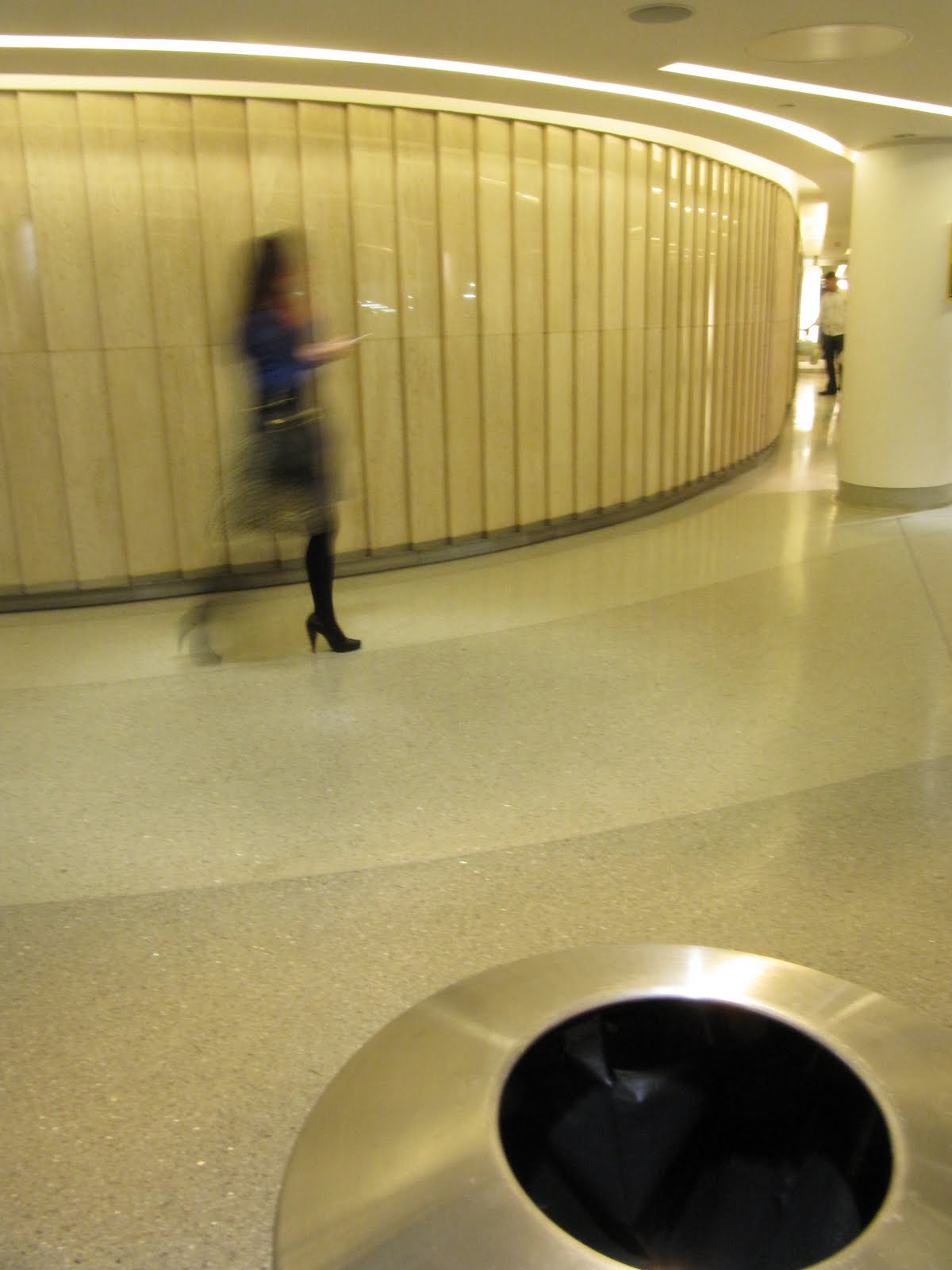


TfL, as is well known, are chary of mechanical reproduction, and, though I had the SLR, I preferred not to use it, afraid the sound of the mechanism, the whir as the system of mirrors chops away from the sensor and back, would bring unwanted attention. The compact, on the other hand, though quieter, and involving a slighter gesture - an appearance, indeed, often more of fiddling than shooting - I discovered in the Underground has other issues, a snowstorm of hexagonal orbs entering any image shot into light over darkness. Blowing to remove dust from the lens, though, found it unmovable, all on the inside, and, worse, moisture from the puffing got in there, too, a thick fog joining the flakes of flare.


It was Ruby, of the Goldhawk Road station café, who’d first made the connection: that a better class of customer could be persuaded in to Westfield from a catchment west as far as Heathrow, east all the way to the sea, suggested to her that more must be made of Goldhawk. Vast engine of gentrification, taking over not only the remaining imperial exhibition White City buildings, but also one of the last of the Inner London goodsyards to have been made over, these spaces around rails – King’s Cross, Paddington Basin, Broadgate one of the first – freed up by the smoother times of IT from goods, Westfield in scale alone a planner’s dream, where the atmosphere, meaning of a vast surrounding area could be transformed in repercussions at a blow. If the council now have eyes on Goldhawk, this is why, and, to sound the depth of the changes – changes echoing across the city, too, gravitational fields realigned - would require a visit.


My 2004 A-Z wall map marks the area in the same cartographic white that drew Conrad’s protagonist, and perhaps before him the man himself, into the dangerous Hell the Europeans were earlier making of the Congo. ‘Site of proposed White City development’ is all it will divulge, adding to the allure with an anomaly: that here in the future could lie the origin of the name.


Because certainly the source is up for grabs when it’s a question no one trustworthy will claim to resolve. Most agree that it appears to have emerged at the time of a 1908 exhibition of imperial flavour, but beyond that will only say that it may have referred to the white stuccoed acres of buildings in the Indian style, negative imports of Lutyens’ export London in Delhi. Having drifted around to the North and West under the gravity of the entertainment industry, the BBC studios and QPR/Fulham grounds, the flavour of the name has now become something of a phantom past or abandoned future, imperial castle perhaps of the air, vast mnemonic blank, calcined battlefront, necropolis or utopia, take your pick.


Above ground, where meteorological indecision veered between rain, grey, and sun to confirm the ambiguities below, shots were equally hard to take. I had of course visited the place many times after a buy, for specific business commissions what with the vast number of windows, or in the general way of research, though the retail world, despite the storm of reviews, is less shaken up by the arrival of something like this in its midst than are the wider behaviour patterns of the city, however much the latter prove less noticed or discussed.
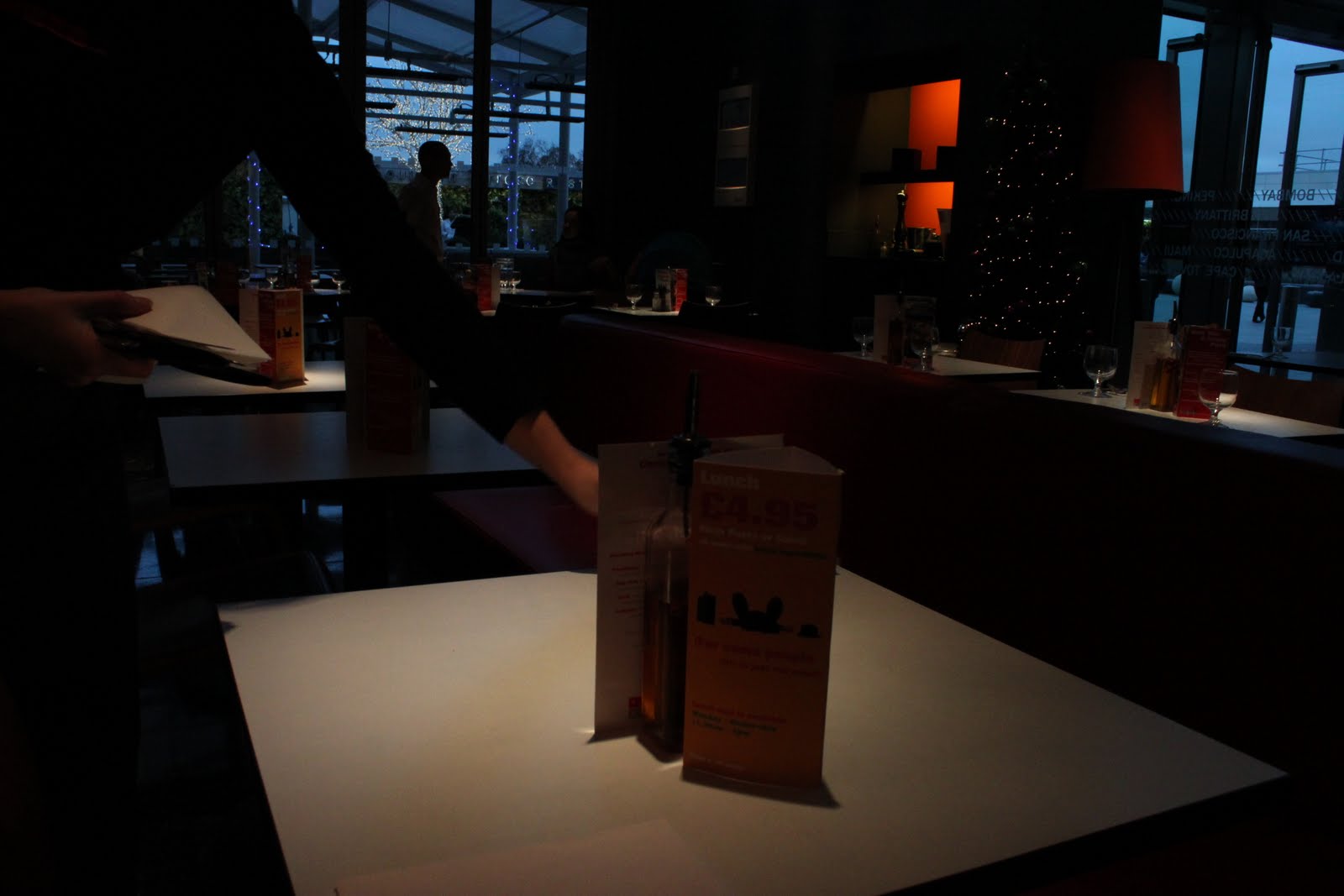


But today I wasn’t there in the way of that sort of research, and, those bearings gone, found myself frequently at a loss for subjects, lacking the pretexts either of work or shopping loosing concentration, drifting for long periods without aim until suddenly a subject appearing to suggest itself shooting something quite other – grasping at what I thought was a shopper and coming out with a reflection, catching a photograph where I’d intended a passerby, fumbling exposure in the vast gulfs staged in the place between light and dark, focus between solid and void, depth of field in a place with multiple layers all surface.


Pushing on into the jungle of crystal and glass, I began to doubt whether the proposed White City development ever happened, the name dropped, after all, for a reason. Although Westfield is certainly in the West as far as the city’s concerned, lying over brownfield land on the junction of the Westway and the West Cross Route, it was in the West of Sydney that the chain the name was formed for drove its first stake into the ground, taking over the field of a farm before mushrooming to include an international portfolio of proprietarily named malls our local’s only a page from. It would of course explain the trouble focusing, the sense of disorientation, repetition of one thing in another, dissolution of scale should Westfield, the concept, turn out more one of activity than place, a sudden change befalling an environment, a removal from context, a gravitational force and set of realignments in which for the visitor to participate must entail the same disorientation I’d been struggling against for shots.


If in Westfield Conrad’s Company comes home, it would be of its Kurtz I should doubtless go in search.


Any attempt at portrait work is of course hard here, few ready to risk being caught by a manager off job, and those who are, not for long – snaps must be quick, slipped in with a sudden chat which itself will illuminate no more than a chance fact from a vast terrain.


Ollie, from Israel, has noticed there a large number of his compatriots, and puts it down to aggression, related to conscription perhaps, a willingness to plunge endlessly into the pressed passage of custom with a smile and a product, an offer to shine the most recalcitrant nails in proof, again and again, undaunted.


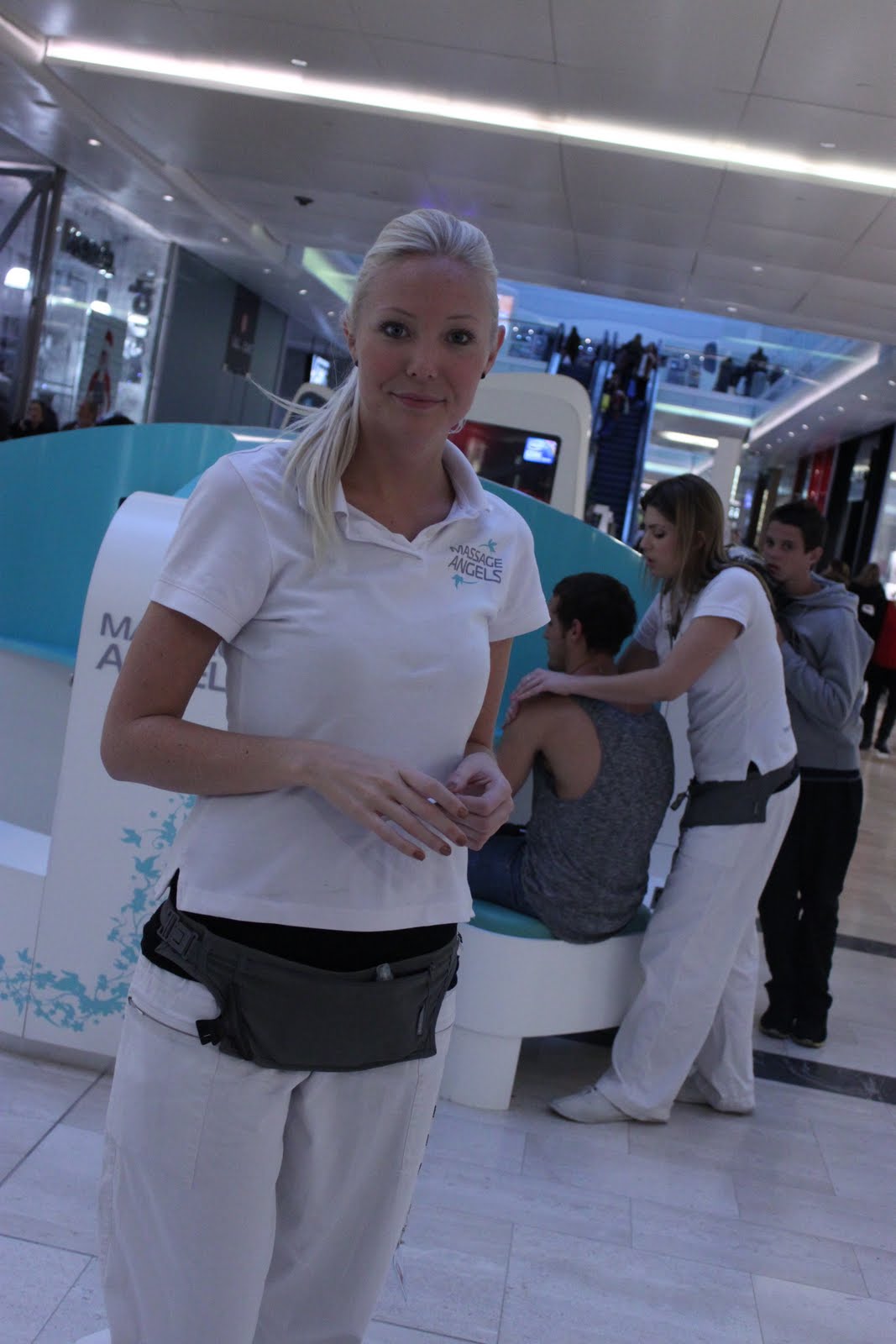
Caroline, from Sweden, mobile masseuse, loves the work, a craft, not being in an office all day, meeting people, grabbing a passer by, a laying on of hands alone relieving them of their internalised burdens of the day, leaving them lighter, suppler, happier.


Daniel, from Spain, found the job on Gumtree, has always worked in the food industry, and was happy to find work in what turns out to be one of the few – perhaps only – stores here independent of a chain. Tapas here’s different of course, without the sociality at home, but the quality’s good, the opportunity.


Of those I meet who agree to a photo, Linda comes from the nearest, in from Chiswick to work the Venture photography stall, selling trips to the Knightsbridge studios with the family, the loved one, for the most important story you ever told, bespoke. What she enjoys is the independence, the place, she suggests, a little town, a world in itself. In this little prism, all the world caught up in an image, perhaps, glittering, to measure, of its requirements and aspirations.


It’s Linda, also, who has about her, perhaps, something most resistant to the tendency of the place to seek to draw them into the disorienting terms, polished, of its own surfaces. However, as I attempt to photograph, I am, of course, at my most self-conscious before this confident mover in a world that finds me a baffled explorer. She seems slightly amused by how dark my result is. Flash is out of the question for the security guards, I explain: as I’ve learned from investigations elsewhere, there’s something about this type of space that resists photographers, must monopolise the production of image, reproduction, surface.


Personally, I’m attached to the way her presence retreats from the wider glare. It’s fine, she concedes, and, going innocently for the kill, as a snapshot, just what you want for a blog. Along with the dark it’s the scale, apparently – a portrait should have more focus, my desire to contextualise by the by.


Too late to remedy this here with this subject, the lesson, though, was learned: if Westfield was itself less a place than an upheaval that befalls one, a search for context, solidity or the fixed – the search for Westfield, in fact, at all – would be distracting from an ability to shoot.


Sunday, July 18, 2010

Sung Like a Canary Wharf: Any Resemblance Denied by the Windowless Consultant


I hold in the camera a head and squeeze, flattening it against the glass, a poster, splayed legs of the Tower and pedestrians beyond, drop it from my eye and await the equation.


The official website, if you include what's silenced along with what's there, says it all: Canary Wharf has been designed with emphasis on creating a pleasant working environment. Careful attention has been given to the provision of public open spaces, including parks, squares and promenades.


Readers with us for the long haul may remember that, largely as a result of my work in window display, I've long had an interest in the -rama, be it dio-, cosmo-, or pano-. Never one to take periods of inaction lying down, I'd decided to fill a gap in work with research, recalling many years previously in the Museum of London Docklands having come across a copy of a London panorama installed in the round, a long lost riverine view recently rediscovered lining the inside of a barrel, or something, as I recalled, image so meticulous in detail people had come to see it -the waterside, boats, buildings, streets, tiny distant people - from all around.


What is that you're taking? asks a voice by my shoulder from behind.


I've been waiting for this moment with anxiety and interest, Canary Wharf notorious for it, but, despite our earlier experiences, I can't quite believe it's true. To the idle eye, the place looks like any other: pavements, trees, roads, cars, people, buildings. Newer, brasher, flash, granted, but with nothing you'd put your finger on as precluding reproduction. Here, then, though, confirmation - as at the British Land Landorama, a place that placed between itself and its appearance this difference by injunction.


I should have seen him coming, doubtless, claims to the photographer's eye surely dependent on the ability to see, but I was absorbed in that one little framed space, all outside it indiscriminately absent, so now there was the uniform demanding answers.


Precision about what it was I was taking would be hard, already the idea that it was taking moot. No, nothing - people, buildings, nothing you know, not taking, just leaving.


This was the first of many times I was to be accosted, and one of the least unpleasant in manner. Certainly intrusive in terms of asking to see other shots in the camera, what it was all for, who I was, whether I had ID, but strangely hesitant, allowing me to skirt the demands, and, if without reason in content, reasoning in form, explaining, for instance, that it was down to the camera, a slightly higher performing model than some (though low-end, SLR), so suspicious; down to me, my dress and demeanour, clearly not from round there; that it was the times, the suspicion of plans to attack; that it may disturb the locals, freak 'em out with sudden shock, psychological warfare of some sort, presumably. Photography was allowed, I was informed, but I needed permission, would be hassled; the street was okay, but not the buildings; the buildings, but not their entrances, exits, windows; anywhere but where there were security cameras, which, there, are everywhere.


As a businesswoman, but as a person, too, I've long been used to gauging dishonesty in explanation by the proffering of multiple cause, laying it on, as they say, and causes incompatible counteract: terror by plot or action, identity, camera type or clothes, the buildings or their users, it was clear, were beside some point that not even he appeared clearly to grasp. Something vaguer, more fundamental, could be felt behind this invisible chasm between London and its first Enterprise Zone.


As a blogger, given the aims within these posts, I've come to see these gaps as key. They are, perhaps, the spaces I'm looking for, may at last afford the camera an uninterrupted glimpse of that moment that I've set myself to track. So, if inconvenient, perhaps the man's confused and contradictory instructions may prove convenient, their restriction liberating.


With this man, as with all those that followed him, pacing the streets looking for issues, standing burly by exits or rushing gesticulating from doors, the response I thought wisest was slippery co-operation, appear at the same time polite, helpful, interested, and yet withhold as much as possible, make no more promises than necessary, express interest in the rules of the place - which required no faking on my part - and yet, once they were gone, ignore them.


Some of the rules, apart from those outlined above, and remembering that contradiction was central to their application, proved to run something like as follows: people dressed in standard-issue business suits enjoyed a basic right to photograph unhindered, though presumably this could be withdrawn should they step outside the expected roles of, for instance, memorialising a business trip at the entrance to a bank HQ visited, or snapping a scene for wives and children at home; photographing the water of the old docks was actively encouraged, though for some reason other than guarantee against further harassment, which was as prompt as at any other scene; retail outlets were strictly off limits, and, lastly, permits were available via the press office, who would drag out the procedure, asking what exactly one sought to photograph at what exact time, though with the proviso that most places were ruled out, what photographic equipment would be used, the purpose, etc., in a game of patience which, in this case, I won, they themselves withdrawing from communication presumably out of boredom before the final details had been worked out, though I didn't let this trouble me, having by then finished the job anyway.


As it's abundantly clear that no terrorist will be hindered by the inability to take photographs, it would be a mistake to believe the danger the Wharf seeks to dispel is that of acts preparatory to terrorism. The absurdity of the overreaction is simply too clear even to imagine that. As the furious response of, say, a be-suited guard to a bemused family of tourists posing in the vicinity of his revolving door for a street shot made clear, the act itself is the object of their hatred, and without any proportion to its consequences - blindly.


Not until my last day there - Saturday, that completely different atmosphere, when the purpose of the place becomes still more obscure, and, as such, a focus of greater interest, clearer - did I get the opportunity to grasp photographically the object of this blindness itself.


If the original purpose of the visit had been, as I say, to capture the panorama, all sight of this idea had long been lost, the behaviour of the guards having distracted me for days, pushed me to research their limits, the effect these had on the images, the space shot, behaviour - that of others and my own; above all, what was behind it, these rigid injunctions half applied, proffered permissions that never came, inconsistencies to the point of whim, one guard placing a not usually where another a never, one allowing what another forbade.


These days I spent wandering this Isle that isn't an isle, and yet, though belonging to London, studiously not, that is. Because the first thing that must be remarked of this corner of East London is the numerous means it employs to suggest it isn't, from the bizarre arrays of clocks displacing its time zone abroad to the toy-town aesthetic, Charliesque checkpoints, retail blingery, price, wage and finally legal exception cutting it off from the rest.


It wasn't till a Saturday I finally entered the museum, getting directions to the panorama at the desk, though I had to revise my intention of photographing it, as here, in distinction to the main site at London Wall, featuring in the previous post, for instance, for their Vauxhall recreation, a no photograph policy's operated, appropriately enough. There, on the wall, I found as instructed the image, shiny, screwed to a wall, and, on closer inspection, a photograph, no less, the original having been shifted. Still, I take the time to look slowly, admire the detail, the reproduction no less useful than the original, though without the installation I recall in the round, recall having visited all those years ago with the Archaeologist in our early days, before we'd lost touch, and then, meeting again, begun blogging together, before blogs even existed, reproducing at least something of what the original set out to achieve. The logic of these things is dependent on the viewer's at the same time viewing what their eyes tell them must be the real thing, and yet being instructed by other details that it's not, a panorama no good of course, if you mistake it for the real, who'd pay to see the real, in distinction to this thing that as exactly as possible reproduces it? There must be that little twinge, the detail that says the buildings here are not buildings, the ways on this land are not ways, this is only a representation, usual life in suspense.


Winding down through the museum, then, I took the opportunity to browse through the displays on the Docklands development, try to uncover something of what the Enterprise Zone meant, the handing of public land over to private investors along with incentives, the extraordinary dispensations as to planning, financing, and transport, the encouragement to think of it as a place apart, a new New World, island without natives, cities of gold, the dreams of a virgin land, strange designations, and, in refrain, the permanent threat of a fall in prices, the endless search for an edge.


On the way out, I took the opportunity to photograph an image from a conversation I'd had on an early day. I'd been trying to take a shot involving shadows and light on some coloured gauze, passers by transparent from motion above. A woman of East-Asian appearance waiting at a bus stop there had smiled, expressed interest in what I was doing. She'd just emerged from Credit Suisse, but details in her appearance suggested she was both of and not of the island, regular visitor, perhaps, from a company based abroad. Perhaps it was just her using the bus, means of transport intended, surely, not for Wharfers proper, but for the cleaners, barworkers, security invited in to serve needs. As ever in these circumstances I was slightly embarrassed about my activities, but let her see the disappointing results, explained what I'd been trying to achieve. The conversation drifting to the specific qualities of the Wharf, I took the opportunity to seek to gauge her reaction to a sign I'd seen posted within the shelter where we stood, almost Brechtian in its eagerness to dispel the illusion elsewhere carefully maintained: This is private land, and no right of way, public or private, is acknowledged over it. The ways of this land have NOT been dedicated as highways, bridleways or footpaths, nor has there been any intention so to dedicate them. All resemblance to real footpaths, bridleways or highways, public squares, promenades or streets is coincidental. The woman had smiled knowingly, though of what I couldn't tell, whether an islander's smile to the foreigner, after all, or one to another. And on the weekends they board the buses and search, she said, even under the seats.