Showing posts with label Featuring Fitzrovia. Show all posts

Sunday, October 10, 2010

The Sacraments, Mercy, and the Last Days of Fitzrovia by the Windowless Consultant



After the previous post, the comparison with the Prado, I needed to revisit the National Gallery, see the paintings I knew in the new light, discover others never noticed.


The Prado has a small selection of Poussins, but it's nothing like, as I recalled, that in the National, and I made my way to the room dedicated almost exclusively to the Seven Sacraments with great pleasure. I hadn't seen these for a while - not since before a recent trip to Edinburgh, where I'd spent time with the earlier and rather different version they have. I would now be able to make the comparison I'd been meaning to ever since. Interestingly, although I'd always considered them one of the most powerful groups in their profound mystery, there had never been postcards available in the shop, and in the Taschen Poussin in the gallery shop, they are not reproduced, being, we're told, inferior to the Edinburgh set. This inferiority had by no means been my impression. The National Gallery series, I recalled, made in some, for instance, a much more abstract use of framing triangles, circles and squares to freeze the actions of the paintings into that strange, almost magical intensity of relations among parts that distinguishes Poussin's works, where, for instance, in a device he often makes use of, the simple fact of a figure's being partially cut off from view on movement by an intervening upright - a person walks behind a pillar or through a doorway - seems to imply motion, not out of our sight, only, but between dimensions, out of ours; not passing out of visibility only, but into something else.


My search seemed, though, to be cut off by a re-hang, the Poussins nowhere to be found, and staff I asked were unable to help.


It was on my way to the downstairs computers to locate the paintings that I chanced on a little temporary exhibition being held there at the moment - Edward Cayley Robinson's Middlesex Hospital group Acts of Mercy and recalled that this was something I had been meaning to see.


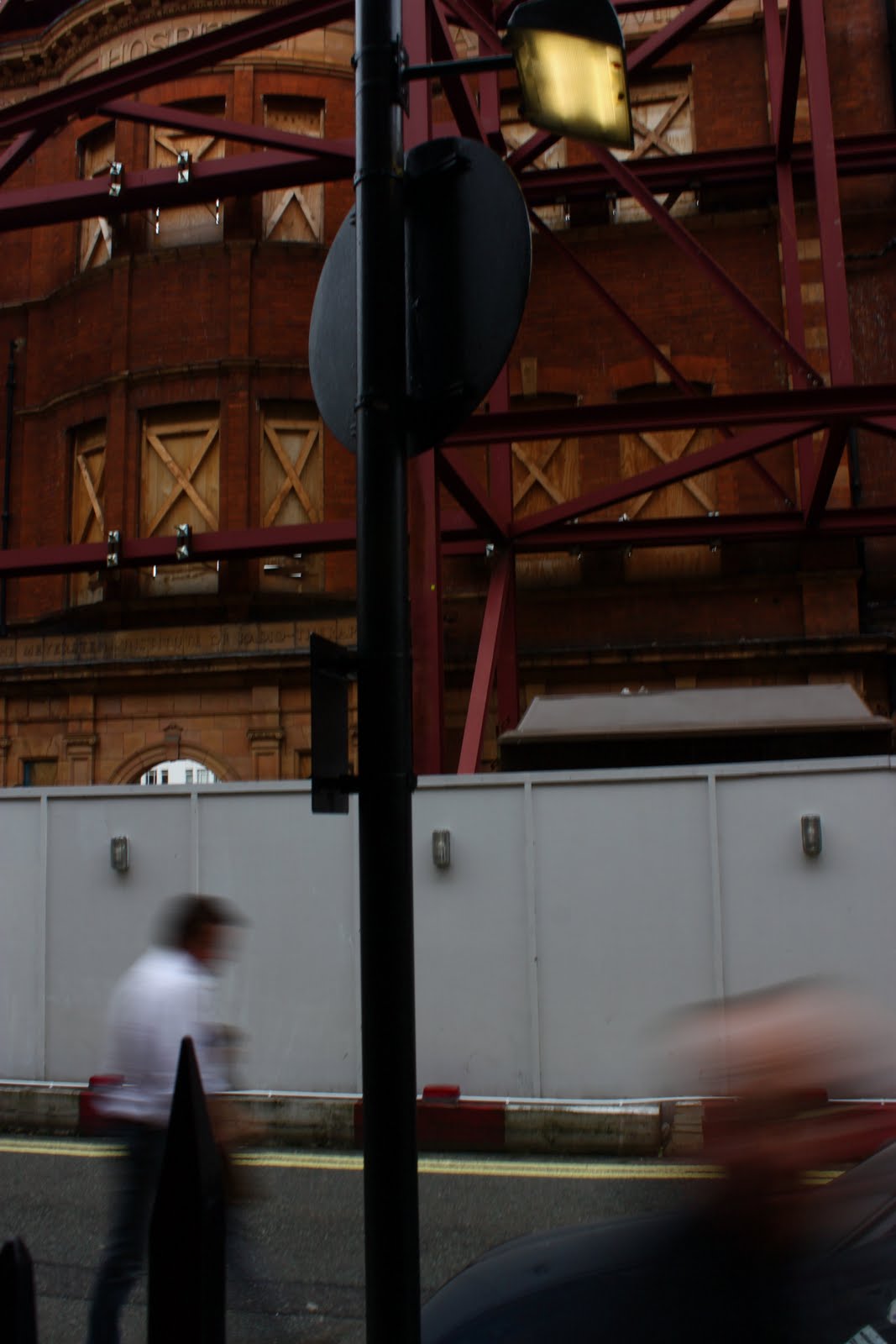
The Middlesex Hospital is a place I'd occasionally considered a post about, and its effect on Mortimer - or, in its prolongation to the East - Goodge Street. I thought it would be interesting, if depressing, to record the effect of its redevelopment by the Candy brothers into NoHo Square, the name, with its functionless central capital serving as a plastic portico, seeking to align the area off with New York by the magic of branding alone, revealing the attempt to send what is a little island of Fitzrovian independence the way that Marylebone High Street so recently went - tarted up out of dowdy neglect and into the exclusive plaything of the international elite who can afford the sort of housing developed by, well, Candy and Candy for the likes, at Chelsea, of the court of Qatar.


The only thing that had been stopping me had been that the story had already begun, the buildings knocked down before I even knew about it, so the post, beginning in medias res, would be without the necessary visual record. I had never once noticed, I have to admit, passing on innumerable occasions in the past, what the hospital looked like beyond its being red brick with greying stone details. Here, then, at the National, would be an opportunity to redress this.


Robinson's series was a double record of the Middlesex, since not only do they depict scenes of the hospital itself, both inside and out, but also, having been painted for the hospital to be displayed in situ, they are in fact a little piece of it itself, removed from the entrance lobby, for the first time since their installation in 1930, only on demolition.


Robinson was clearly something of a Symbolist, the realism in his paintings set off by a strangely timeless poise giving his figures hints of that mystery that haunts the viewer in Poussin. The canvases are of very large scale, bringing the refectory, the courtyard spaces, with classical foreground porticos framed by Bloomsbury terraces back- from Mortimer Street into the National Gallery's Sunley Room and shrugging off the lack of substance, the hospital twice demolished (the Robinsons are of a previous, reputedly more elegant incarnation), with an ethereal lightness. The viewers in the gallery space entering the friezes of orphans, patients, nurses, families and doctors they contemplated would be a perfect photographic document, I realised, of the hospital that was. In the etherealisation of the transformation to a symbolist framework, the physical sustenance of the orphans became the spiritual of the gallery visitor, coming together with the paintings, given a temporary home, to recreate the hospital in the imagination before its destruction in reality. I left excited that perhaps I'd be able to pursue the Mortimer Street project after all, using shots of the series in this new situ standing for the old, the Sunley room a street saved, briefly, from, if not total destruction, damage beyond recognition.


If that seems naïve - if I should, perhaps, have realised that, since the paintings belonged not to the gallery, but to the Welcome Trust, they wouldn't have even the right to give me that permission - so, perhaps, should my blind confidence that I would again be viewing the Poussin as so often before.


The paintings, like so many others in what we call the permanent collections of what we call our public galleries, I thought of much as I thought of what we call our public spaces - part of our shared landscape, something that would always be there, unproblematically, to visit, whenever I'd need whatever that sustenance is that paintings bring. In fact, it transpired, they were a loan, dependent on the continuing largesse of the Duke of Rutland, an informed and enlightened guard at last informed me, a largesse which the continuing health of the art market has recently been putting such under excessive strain that the man has decided to explore other ways of enjoying his family's rights to privilege.


If the art market's managing to keep it up, the property isn't, and the Middlesex land has dropped sufficiently in value to spare Mortimer Street at least a little more time to itself, albeit diminished, gaping in its middle at the site once given over to charitable causes. This post, then, if it can't reproduce what the street once was, can at least seek to show what it soon no longer will be.


Sunday, February 14, 2010

Notes from the Pompidou, by the Windowless Consultant


Sitting in the Pompidou café, taking notes for the present post, turning towards the window to produce a photographic record, I was unsurprised to hear a young couple to my right speaking French. This, too, should be noted.


I've mentioned our Charing Cross Road Foyle's Caf meetings, where the three of us align sights as to the direction of the blog. In our last meeting, we'd discussed a comment by fellow blogger Izoard, who wonders whether reality may be disappearing under the sheer mass of photography, or indeed whether the reverse is true. Perhaps at some critical point of apparatus ownership rates, the Landless suggested optimistically, starry eyed, I believe, after his experience in Trafalgar Square, with cameras everywhere, things, having no corner to hide in, may at last appear as they truly are.


The Archaeologist demurred. It was his belief that the camera was a tool like any other, a microscope, a brush or a trowel, that could lead as much to error as to truth. What we all agreed on was that, given the growing place of the medium in this blog, we ought to decide where we stood.


What would be needed would be to return to an earlier time and compare the degree of reality then manifest with that now. Consider the comparative camera review now commonplace: does the Nikon XYZ or some equivalent Canon have better performance, they ask, meaning basically, the image of which is more real? The best reviews will display comparable photos side by side, for the reader to judge. You'd want the same basic comparison, but of historical moments rather than models.


The Archaeologist, emerging from silent study of the swirls in his macchiato, agreed. Compare photographs from now with others taken at the medium's inception, when it hasn't saturated the world to the degree it now has. The British Library hold a great collection of these early imprints. Their present exhibition, showing a broad selection, was clearly a perfect time to put this to the test. Surely that should be the subject of my next post - this one. The library being on Euston Road, major artery in itself and locus of several mainline rail termini, he'd wandered over there while waiting for one of the Chunnel trains that never came. We'd all benefit from the inclusion in the blog itself of this comparison. Here would be our opportunity to decide on the proper place of our illustrative photographs.


The Euston Road, along with its continuations east and west, is one we've been on before and one, choking but inspired, toking fumes and blare, as I made my way up it, I knew I'd be back to for more. It has that particular kind of charm that vast amounts of traffic can impose on a place - a roaring anonymity harbouring pools of obscure specificity, its attraction, like the landscape of a distant planet, in part its hostility. Passing from the eponymous station, I felt the hidden force of character that had imprinted itself so clearly in the last century on certain painters: Bohemian but gritty, accomplished but obscure, the Euston Road School were in equal measure favoured and condemned by location alone to approach but never attain illustrious kinship with the Fitrovians or Bloomsburians. A place of transit, I reflected, few would have the strength to grapple with and win.


Whether or not St Pancras New Church won is moot. The alluring caryatids are of course based on the most academically correct models of the Grecian. What the architect couldn't know, building the place just before the advent of rail, was that their roadside poses were soon, with the coming of the stations, the cheap hotels and transient populations, to appear dubiously to reflect those of their living counterparts beckoning drivers from below. Now even with the area being cleaned up and the living girls moved on, the statues still quiz me archly about a return to business as I pass.


As I'm here to blog, I try to take note of things, activities, atmospheres on the way. But it's hard to engage the surroundings, the area changing so entirely it's impossible to decide whether the remaining gas works, the canal, the tenements have any associations anymore, whether, under these vast 'regeneration' projects, those historical sites deemed worth retaining don't become only images of themselves, sucking the visitor with them into bearingless drift. I head to the exhibition, a little relieved to escape the implications of these thoughts, to be back on project.


At the door, though, a change of plan. No photography. I could only research for the blog if I forwent any attempt to gather materials. The instruction at first perplexed me. The photographers represented had all long passed away, surely taking copyright issues with them into dust. What was to stop the free proliferation of their images now? Perhaps it was physical: flash, technology of another time, may destroy these delicate early images. But couldn't we be asked to forgo, not photography itself, but the use of flash? The arguments were idle: there were other necessities at work, though, I suspected as I left a little while later, denying me conclusions from what was in itself a fascinating show.


The circulation and refreshment areas were a little less busy now, but the mood still more studious if anything. This had been my first outing specifically in search of blog material, and I hadn't expected this kind of resistance. Perhaps this itself was what I've elsewhere called the imminent disaster occurring with everything unchanged, the window smashing onto the street, the world becoming props to hover in mid-fall, the subject disappearing. Research in the lobby went on in its near-silence, discussions hushed. In the windy courtyard, Newton bent, noticing nothing, over the same unfinished work. The equal traffic flows opposing their directions still argued out the sense of the Euston Road.


Continuing West, rounding a corner, I come upon a bookshop I've never noticed, but which would appear to have been here since way before the changes. In the window, books on London, local lore. Here, perhaps, I would find material for a post, if not, as planned, on photography, on the local area itself. Entering, I browsed a collection whose difference from what we've become used to with the stranglehold of the chains confirmed what I thought: the shop was a limpit, clung here since long before the recent turn in tides. As I push on in, the focus on London gradually gives way to one on Paris. Eventually, it reaches its zenith in a set of shelves whose label promises to explain: 'The Situation is Movement'. I bought a book promising to explain it on leaving, The Situation is Movement in the City, which I took with me back onto Euston Road to have a first look at in the Pompidou café.


The Situation is Movement would appear to refer to some sort of group originating in the recent past devoted to uncovering qualities within specific places which, as far as I can tell, may be akin to those sought on this blog - may be instructive. One of their methods would seem to be the description of one place by means of another, members, for instance, using a map of London to travel around Berlin, cutting and splicing maps to join non-contiguous locations, investigating deep into the specifities of the commonest locations for powerful but unnoticed effects on the mind, behaviour.


Sitting in the Pompidou, I was unsurprised to hear the young couple to my right speaking French. The rail link tunnelling out of London, under the Channel, into the Gare du Nord, the tube lines now enmeshed, continuous, was only part of wider changes. The student flats arriving, pool halls closing down, the kebab and sex shops clinging on, the cafés forced to spruce or go the way of the junkies, the closure of the Scala cinema with its all-night screenings - The Trip, Into the Valley of the Superdolls, Easy Rider - each a part of broader movements, all to be tracked, logged, mapped.