Showing posts with label Albertopolis. Show all posts

Saturday, October 10, 2009

No Sign of Albert by the Landless Landlord.


To identify where the signs are going, it was about time I addressed what they do. While it would be absurd to say that the sign is the name, nor do they just illustrate it, since the name - the Carpenter's Arms, the Dog and Whistle - clearly follows the image, not the other way round. But, since nor does the fact they should be attractive, of course, mean that they only adorn, or that they're noticeable exhaust their purpose in the beacon, I realised that the function for me, after all these (those?) years in the industry, remained a mystery. There is the pub, there is the name, there is the sign, but to sense suddenly in the repetition profligacy, the sign, for instance, an unnecessary addition, would have been to side with their reduction - names, signs, pubs - and by fifty-two a week according to the most estimable estimates. They form a trinity, mutually dependent facets, but each to be admired in itself. At the same time, I had no explanation for why, and for justification sought more examples.


After the Angel, where the name proliferates but the sign is long gone, it seemed to me wise next to consider the opposite scenario. A good example was sure to be the Albert, since there we have the manifold signs for the one name - with Arms or Head appended, the Royal or the Prince.


Since I live East, I picked a couple to visit on the way in towards town by means of a Googlemaps app.. First stop, though, Elia Street, off City Road, the Prince, already was erroneous. Here was no Albert, but an essayist in profile view, the city he presumably loved, lived in, described, addressed, some instruments of his work, and samples in quotation. The nature of this one, hovering, wavering between image as picture and as word, perhaps this might tell me something about the demise of the hostelry tag as medium, but also its fight for survival. The words after all were not image as word but word as image of word, the notebook not a notebook but an outline of a notebook, there to denote the man, the pub sign still a pub sign then, not a description or a name tag hung on a wall. The essayist being one of life's loggers, that here he was doing whatever it is pub signs do and that I must discover seemed in itself noteworthy, and although I'd thought at first my research had been fluffed to have led me here, all was not lost if a lesson was to be learnt. A pub sign could be a kind of protoblog, seemed to be the message, or perhaps even, I wondered, with a mixture of excitement and remorse, a blog a pub sign, a part of their disappearance or a hand in their renewal.

Next stop was a house of the same name on Acton Street, where I understood what had been - and what an extremely useful site, a kind giving not pub but ex-pub addresses, a kind of anti-fancyapint, or fancyapint of the departed, has since proved to have been - the source of my previous disappointment, too: not a googlemap error, but a result of change of use, the earlier to the Lamb, this place now to from Prince Albert proper to Konstam at the Prince Albert. Inside, instead of taps, the offensive sight of coffee and wine, tables all with napkins folded into glasses, not a beer mat in sight. I like coffee very much and love wine, but at the expense of beer, in the Konstam, they were agents in the demise of the Prince Albert. An accompanying agent, of course, was the removal of the hanging sign, featuring, as must be presumed, its representation of the royal - no mere ornament, then, signs, but an intrinsic part of what the hostelry is, which, for the hostelry to move on, must go.


The only other Albert I recalled, to continue on my trail, was in Kensington. The fact that this one was no pub sign at all was an important part of why, I sensed, I had to go there.


But the result was unexpected, so clear it was impossible not to suspect causality. Everywhere in the city, on the signs, his portrait disappearing and with it even the name, and then here, at the centre, the opposite, the portrait incessantly reproduced, cameras from all over, not just London, but the world, descending on the area, filling the air with their clicks, noisy, barely perceptible, or, equally, silent. And the sculpture was pre-figuring the actions of the photographers. Dictating. The urge to photograph was automatic, unconscious, it would seem, irresistible. In some way the idea was to suck the outskirts dry, the centre becoming increasingly dense, repetition not only of the act of photography, but also, and reflecting the repetition of the picture a photograph takes of a scene, the image the photographer makes of the seen, their gestures those of the stones. Here the air became a crystal medium, movement jagged and interrupted, ritualistic. I had not understood until now. This, then, was why I, too, had come in search of Albert, felt my own arm rise, camera in hand. Deflecting the force from the statue, perhaps I could at least focus, not on the sucking centre, but on his reflections everywhere abounding, multiplying off each other, each passer by a facet, of the crystallized spirit of the man - appropriate the power for myself.


This was not the chaos of Borough, clearly, though at the ordering system for now I couldn't guess, just record, work it out later. The repetition was kaleidoscopic, one photographer going, another arriving appearing to disappear and reappear, the same, but different, reflections of each other, themselves, the stones, folded into and out of the revolving facets of the very air. This man, for instance, who seems to be taking a photograph of this woman reading, reproducing the man reading behind her, the stone looking back at her with the force he's tapped of her life. No, who's looking at me, this man, photographing him, who's a man I've seen before, a man I know, knew. The man who's come to be known as the Archaeologist, I find, and who, as me, as though we'd never lost contact, had always had this rendezvous, had been drawn there to the memorial in search of material for a - this, it will turn out to be - blog.


From here on detailed account is superfluous, since it's been made before in the blog that this one is now itself joining, but I feel perhaps some reduplication is nevertheless necessary for a sense of completion and unity within the post, to express our surprise, for instance, as we did, at seeing each other there, and how little we'd changed since the university years, how we wouldn't perhaps have recognised each other, though, still, after so many years, the way you don't, unless we'd started thinking about each other recently, something about having lost our jobs, thinking back to before, our university days - his when he was at it, mine when I was near.


I feel I've been approaching something in these posts, the experience at the monument the nearest, but I don't know if I could arrive at it alone. It's for that reason that I agreed to join forces with someone from a so distant past so propitiously met. I don't quite get his reasons, but the compulsion was contagious, and that he feels we share a search is promising. Since, in fact, loosing the steady work, I've been mentioning the man increasingly, in these posts, and his girlfriend, or rather, since I no longer knew him, the student that he was, the girlfriend she then was. It's almost as though it was them that I'd been looking for, though of course, not least since, having now found them I feel renewed vigour in the search, that can't be the case, that would seem to be a red herring of some sort.


This, then, my first post with the archaeologist and the consultant, the last on Pubsignstakenforwonders, where I've packed the bags into a bundle to unpack them integrally on The London Archaeologist and the Windowless Consultant, tying my dates in with theirs, but maintaining my own label down the side.


Monday, September 21, 2009

The Temptation of Albertopolis by The Archaeologist


I went in order to research a hypothesis arising from The Windowless Consultant's last post. It would seem that there is a force in the area drawing those passing through at least parts of it, not only into the superficial behaviour, but into the very status of the statues. This may either be a result of the people's being effected by the statues or the statues the people, the people who made them, or both.

The means that I had chosen to track the phenomenon - if phenomenon there was to prove to be - were those that have become my staple. There appears to be something about the stills camera that makes it the most satisfactory means of pinning down aspects of the world that one knows to be there, but which are somehow obscuring themselves behind artificial resemblances to other things. Perhaps it's time, perhaps space. Perhaps it may be that what in one moment in certain area separates a thing from the others it may appear to be is lost in the next without something to freeze them out.

It's known that Albert, in building what became affectionately, humorously, though, I believe, for its accuracy, should perhaps better be considered ominously Albertopolis, was attempting to influence the public. This tends to be taken to mean that the populace was expected to study the excellent museums, architecture, and statuary of the area and somehow learn from them to create a better world. This, I have to say, has never convinced me overmuch as a notion. Surely there must be subplot.

As a once archaeologist, I've experienced at first hand that what are generally considered to be traces of a past world are in fact parts of a present. A dig is not some cessation of everyday life - potentially intensification. I'd never have put it that way while in employment; perhaps it's one of those things you can't see from up close. An archaeologist isn't an antiquarian. My aim in setting out, I recall, which unfortunately I'd long lost sight of beneath the daily grind, was to learn, through an investigation of the past, free of it, at last to be there for the present.

I say an archaeologist isn't an antiquarian. I'm discussing an ideal world. In many ways my trip to the V&A and its surroundings was with a view to tracing out the boundaries. Perhaps then when work picks up I can engage in it more knowingly.

Albertopolis represents Victorian antiquarianism as political, philosophical and cultural system. Are we free of it? The essence of life shall be emulation, and, since the models to emulate are models, its highest aim would be the status of modelhood. What is remarkable is that, in this area at the same time so clearly defined and yet so easy to confuse with the city as a whole, the aim is achieved so perfectly it goes unnoticed.

To achieve my aim of drawing attention to it at last, I set my camera to recording the ways in which the statuary of the area - surely London's densest for public sculpture - imposes on the inhabitants behaviour aspiring to repeat it. Albert's message is posted everywhere both literally, in exhortations to admire, commission, learn to create, engage in crafts emulating those of the past, and in representations of people, both of the past and the present, who are taken to represent those practices. What's stunning is that, despite this, those who go there consistently appear not to realise that the exhortations have been given the power to force their object on - and from this group I don't pretend exclusion - the unwitting: somehow, by a power be it symbolic, geographical, verbal, architectural or so far unnamed, the behaviour of the statues and that of the passer by inextricably interact. It's not just that the public become in some sense like statues under the stultifying influence of so much tradition, for instance, in so little space - I'm not in the habit of that paranoia peddling threatening to have the blogosphere sewn up - but also that the statues become like members of the public, that they start, live, engage with and act unnoticed on their surroundings with the stolen collusion of whoever's to hand. Albert lives.

However, it was as I focused on one such incident that a mounting self-consciousness made me turn round.

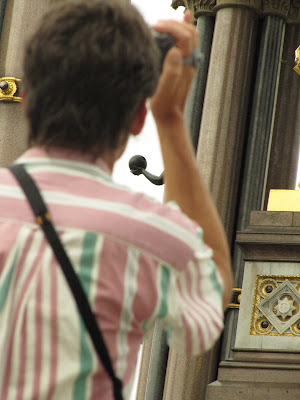
I myself know that it's extremely easy to appear to be photographing a person when in fact one is photographing a notable object of cultural interest behind them. That is what enables the street photographer, or, in my case, aspiring archaeologist of the present, to include passers by within photographs without their being distracted by one's having to ask them for permission, since it follows indistinguishably that it's also easy to be appearing to photograph a notable object of cultural interest when in fact seeking an image of a stranger standing in front of it. However, it's because I myself am so often obliged to pull this trick in the way of my own work here that I was in this instance not remotely fooled by the attempts of the man behind me to suggest by his innocent appearance that he was quite unaware that the object filling his zoom was not Albert at all, but myself, attempting to photograph in turn a member of the public whose gestures, reading a guide about the area, interacted with an unconscious attention to detail that could only have been intentional, with the carved stone figures before her. The question whether the statues drew them into their cold still world, or she, on the contrary, fed mammalian life into the stone I would perhaps resolve later. At that moment, with a mixture of calm and excitement, involved but detached, I sought only the image.

There's no reason for a person photographing others to be happy to be photographed themselves, though no defence should they not be. I fixed the man with what I hoped was a sufficiently subtle blend of irritation and indifference to both convince him to desist and deflect any suggestion that I should hypocritically be seeking to do so.

The man, dropping his camera hand to his side, first frowned and then smiled, tilting his head quizzically before shaking it in disbelief and exclaiming my name and expressing his surprise at how little I'd changed. The man's genuine and direct smile worked to soften the discomfort I felt at not only having been caught out like this, but also now this one-way recognition that left me defenceless. It was a smile that I recognised in turn, and manner, but in a past so unlocatable that the recognition only destabilised me further. I'd been caught so unawares, photographing others I believed unaware, but what exactly the man had taken with my image I couldn't even guess at.

I accepted the offered hand, then, and allowed the searching gaze to attempt to jerk me into a recognition that was stubbornly unforthcoming. Mile End, he explained, the Arms, as we had indeed used to affectionately refer to it as, and it all came back. I recall making posts on the pub earlier and indeed entries on it by the Windowless Consultant, the barman in our university days our friend, so I don't need to go into details here - perhaps a label's in order, though: the Arms.

We'd felt back then much in common, had even planned things together after university that, of course, had never materialised, but so now to find that he was - is - engaged in a blog which, from his account as we sat on the steps and reminisced, updated and compared, has many concerns in common with this one, surprised me less than it explained: why, primarily, my sense of disruption and how, restoring my sense of balance, to free me from the uncomfortable sensation of having been shot.

I'll leave it to the Landless Landlord, as he's come to call his blogging self, to explain in detail what had had him taking the pictures, and his eventual aim. There I was, though, in his camera, holding up my own at the reading stranger. In my excitement I'd thought of myself as somehow excluded from the scene, as uncovering a behaviour in others with no effect on my own. But it was quite apparent that my gesture, and, perhaps, the gestures I've been making all along with the camera for the blog, were prefigured no less, perhaps still more by the project of Albertopolis than those I thought I could only shoot. The act of blogging would no longer be a record of things going on in the world, then, but another alongside them, and not only that, but incorporated within his. To incorporation in itself I could make no objection, but what I'd been attempting to do didn't concern myself alone, it was intended for everyone, to release us from the hold of Albertopolis. For the Landless Landlord to include me within its very centre, the frozen heart itself or the living stone which is the work of the Memorial would risk undoing in fact precisely what I was only then finding myself free to do. I wasn’t sure I'd be able to go on with The London Archaeologist at all as a blog, I explained, unless he agreed to include at least that entry of his - Pub Signs Taken for Wonders, it turns out to be called - here on ours, at least alongside his.

I'm glad to say that he was very happy to do so, then, and I'm sure readers will agree that I've taken the right step in suggesting since that he bring his blog in its entirety over to ours. It was looking at it in the light of our conversation that I realised that there's much in our projects that's similar, and posting together will combine our forces more favourably towards realisation.


Sunday, August 16, 2009

Between Cabinets at the V&A by The Windowless Consultant


The thought long haunted me that somewhere in the V&A to anyone with the key, who could find the cabinet, secrets extending far beyond design, into the most esoteric nooks of existence, might be discovered. The thought has always been an idle one, something in the nature of a dimly glinting not so much awareness as sense, and since for me idle moments had long been few, one I'd never had the opportunity to pursue.


Of course my trips in the line of work have been innumerable. I've only ever met one London-based window consultant who wasn't intimately familiar with the place as a source of inspiration, but in my experience opticians tend to live in a world of their own. Although my visits had always involved searching for some particular item, fact or design - the style of a Chinese temple, the decoration of the Crystal Palace, possibilities with cast iron, the exact appearance of an angel in flight - I'd always be troubled at some point on a visit by the sensation that there was something else there that I was missing, at the same time deliberately ignoring, and yet because even if I'd wanted to, I'd have lacked the means, not only to see, but even to look out for it. Call it a flickering in the corner of the eye, but of something subtler than colours or shapes, not so much the beginnings of an appearance, more a dim suspicion that there might be something that could, hypothetically, appear, less an exhibit, perhaps, than something about the spirit of collecting and its limits. Such, then, the intimations wafting elusively around the corridors untagged.


Because the place is stuffed with models, casts, proposals, examples, styles, designs, is itself in its architecture, layout, intention a further set of models, proposals, casts, designs, and styles, the idea that anything else than that should be sought there - that something about, not what people, societies the world over have said things might be made to look like, but what they are, for instance, might be found, what the world is, the universe, what it is to tread it, to breathe, eat, dream, to look there for answers, love, a home, adventures - would have seemed beside the point. Perhaps, at the time, if I'd asked myself, I'd have said that it was my firm belief that anyway, from life in general, what we ought to seek is in the nature of decoration: that the merit of the belief systems that have populated the earth through the ages is to be decided not according to the degree to which they match some reality they'd model, but rather according to their relative beauty - their beauty in themselves, in their role in their society, or as a part of the universe of which their society is itself a part. To the question, for instance, is there really a chance we're re-incarnated after death in the form of an ant the answer I might have given would have been yes, that is indeed a beautiful idea, in itself for its strangeness, socially for the elegance of its solution to the problem of selfishness, metaphysically for its expression of the interconnectedness of all things, of change, the relation of thought and matter, the shifting boundaries between the known and the un-. And yes, I'd say, I also believe in angels, particularly carved in wood, figuring in paint on a gold background, or Raphael emerging from the hands of Milton.


But at the same time, even though I don't think I'd have put things in that way, if only for lack of the time to phrase them, patience with the attempt, belief it might be worth it, the notion that the museum could teach me about the world as a whole, the universe as it's inhabited not only by humans or even animals, plants, or even only also things, although I can say retrospectively that it was that intuition that shadowed me as I searched out my design solutions is one I'd never until I found myself with this idle time allowed myself to entertain.


How many times have you been in love? This is a question, it seems, each new lover has to ask me at least once. Honesty hasn't, I suppose, always been a forte, and I've tended to seek either in their expression or my own mood for an answer. Are they pleading for me to tell them they're the first, and if so, is that what they really want, or need? Do they deserve the reverse? Is their look wicked, conspiratorial: will it be a high number that most pleases? Is there any reason why I should care what they want? Shouldn't I rather say whatever will most distress them, most pleases myself, dispenses with the need to think, punishes the error of seeking an answer?


The V&A's universe is one in which an encounter with things is always guided, chaperoned, by parties of others, but who hover always on the edges of vision. The traces they leave as they move out of the path of what you see are perhaps all they are. It's in that sort of thought, perhaps, that my own intuitions most meet the Archaeologist's.


We met, as I recall now, in a pub, run down affair, in time off. There was a reading group he was in that used to meet there, he had me join. Nobody ever seemed to have read the books, but the discussions were full of an intensity either naïve or visionary - it's too long now for me or anyone else to seek to arbitrate. I remember the young barman used to join us after closing once the doors were locked. 

I went with him to the bar once alone to get a round in, the group off behind us in a corner. He looked at me with a smile while a stout cleared black in its glass. The trouble with us students was that we were all so spaced on undigested theories, and the trouble with him was that he was so bogged down with work he couldn't swallow them. Did the fact, he wanted to know, that between us we seemed to manage such understanding depend on the beer, the drugs, the place, or a real affinity? Although I smiled, I somehow felt defensive. Perhaps this was some sort of proposition. He knew I was with the Archaeologist (to be), perhaps the most studenty of us all in the same way I was surely one of the least. 


Any similarities between the Mile-End pub and the refreshment rooms of the V&A would surely be hard to pin down, but something there on this last trip made me recall the conversation, and wince at my answer. If it had been disingenuous to deny the understanding between us, though, perhaps that was because what he'd meant had just been too elusive for me at the time.


In all honesty I've been in love, really in love, I've sometimes thought, three times. Three known times. And yet I do wonder how many other times I might have been, how those other stories, too, began and ended. These can only be known, perhaps, by analogy with the times I'm aware of, fleshed out with the accounts of others. As eluded to in the refreshment rooms of the V&A, I wonder whether they've only been with people, what affinities we really have with other things, qualities of atmosphere, arrangements of things, currents of air or light, traces of movement, to name some, only, of which we're most aware. 


I do have jobs: they're just less frequent than they were. My last one involved a Knightsbridge jeweller's, was so well remunerated I stretched the term towards its synonymy with 'heist'.

For the brief, we sat back-store in the office, the manager, a woman he failed to introduce who mostly nodded, champagne on ice between us, a table, choice pieces displayed. They wanted, he said, something romantic. That was an extremely wide brief, I suggested, and perhaps he could be more exact. What, he wanted to know, was romance for me? The other woman counted the bubbles above the mouth of her flute. The cut of her skirt was perhaps responsible for her stiff appearance. If she'd uncrossed her legs I'd have been able to tell you more about her anatomy than you'd perhaps want to know. Something in the atmosphere told me the manager already did, perhaps only for having thought so hard about it.

Lies, I said. Hypocritical excuses for a bodily pleasure that didn't need them. The silent woman smiled, sipped, crossed her legs the other way, looked up. The manager looked back at her and then at me. That's what he wanted, then. He smiled, raised his glass.


I knew what would work, needed no research. A trip to the V&A would furnish me, not with ideas, but with something extra for the invoice. 

So my visit there last week, for the first time, was one without aim, although on my first job in a while now, the first that was purely idle.