Showing posts with label Pimlico. Show all posts

Monday, April 5, 2010

More Pimlicos, Past, Present and to Come by the Landless Landlord


To All Trauellers, Skelton suggests in introduction to Pimlico, YOu that weare out your liues and weary your bodies, in Discouery of strange Countries, (bee it for pleasure or profite) Rig out a Fleet, and make a Voiage to an Iland which could neuer be found out by the Portugals, Spaniards, or Hollanders, but only (and that now of late) by Englishmen.


I don't know how much literal truth Skelton can have intended in his image at the time, but certainly he can't have known how true it would become.


It's not only the signs that shift, go down, come up, name suddenly different things. If also, as I'm discovering, not just the people, but also styles, habits, moods, buildings, the earth itself of the city move, sometimes independently and others in concert, and if the names for things sometimes accompany these movements, sometimes oppose them, or follow entirely independent courses, it may not be possible to attempt to establish long-term facts, but only to develop enough sensitivity to their movements to form tentative logs.


Too long I used to ignore these shifts and flows. This was excusable in a period when I barely had time to emerge from behind the taps beyond a trip down to the cellar to change a barrel, vent a cask, or upstairs to fall exhausted into bed, but it's no longer possible. Occasionally now, passing through some much visited area, I'll look up at a row of shops, an alignment of houses, a street layout, and, feeling I recognise it, be struck by a sense of disorientation. It's as though the moment I believe I'm in the same place for a second time I've succumbed to an illusion, must look more carefully, move on, perhaps return in another mood or from a different approach having learnt something new, disarmed myself of some assumption.


I already realise that if I don't return to Pimlico some time in the future that'll only be because it's somehow returned to me, and if I don't realise that, that'll be because it's under a different name, with new owners, its style has changed, atmosphere, appearance, ground.


I originally thought I'd say here all there was to say and be done, move on. The idea's absurd. Google it. Among the growing thousands, millions of references, for all the information that's shared, the facts, conjectures, opinions recycled, renewed, you'll find hardly two that agree on a single detail without another about which they differ. And if they do seem the same one day, come back another and something'll have changed, one of the sites will have unearthed something new, responded to some development.


And all this despite the fact that one of the things that creates a certain amount of agreement about Pimlico's that it seems to respond more slowly to changes than does the surrounding city. Phil Baker, in 'Secret City: Psychogeography and the End of London', refers to the special 'time zone' of Pimlico Road, and how the first Starbucks to have arrived infringes on it. The place of the cafe in gaging these things is well known, the fate of the classic logged elsewhere with as much concern as that of the pub sign here. That Pimlico was so late to get these chain cafs, supermarkets, and many of the other of the alterations taking such a grip on so much of the rest of the city isn't accident. Wikipedia describes the 'highly disciplined grid of residential streets' as an area 'separated from Belgravia to the north by Victoria Railway Station, and bounded by the River Thames to the south, Vauxhall Bridge Road to the east and the former Grosvenor Canal to the west'. Being cut off, then, by features both man made and natural is part of its essential nature, part of what the name names, and this can easily make it seem to inhabit a slower time.


That at least was my assumption on my last couple of fact finding visits, my aim to record the ways that was true, log the chains arising, record the effects, their slow pace. In fact, though time in the western Pimlico certainly passes differently, it would be a mistake to put the difference down to speed alone, not least given that it's inseperable from qualities in the space.


Besides, the place has always been rich in innovations.


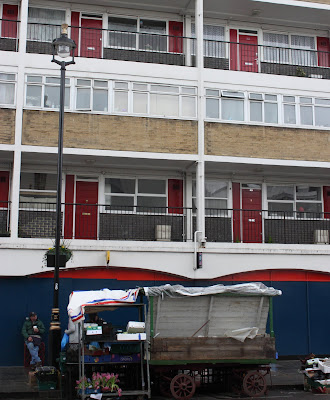
Churchill Gardens to the South was the first development to contain a space of lower slabs within higher blocks, and the Thatchbrook estate to do such higgledy-piggledy dense. Enterring the district through either of these experiments still leaves the visitor with the strange sensation of having stormed a walled city. These feelings remain novel even now. The Thatchbrook's willful. You can't move two yards straight, are only allowed to traverse after a certain minimum of twists and turns, up and down steps, through dark passageways, across quiet squares, under balconies, round the thick trunks of age-old trees has convinced you that, if you do arrive on the other side, it will be to find yourself on a road winding down a slope in Umbria, Turkey, perhaps the Alps. To be once more confronted by a familiar terraced brick street only adds to the disorientation.


Pimlico was the only place of its scale in London to be developed with such careful uniformity of plan. The almost comically apt name of the developer at times seems to offer a key, Thomas Cubitt having let rip there as nowhere else. The vast stuccoed terraces of its core grip the visitor with such crystalline rigidity the repetitions become indistinguishable from illusion, and so illusion. Either such exact repetition is the result of a more limited series being multiplied in reflection, which is impossible to believe, or else every street, every house you see's real, individual, but that's impossible to see.

Another of the most frequently sited Pimliconian facts is that, in order to fill in what was originally uninhabitable marshland, Cubitt brought earth from East London's St Katherine's docks. Everybody seems to understand there's something essential about this, I reflected, staring at the tastefully coloured stucco, but nobody will say what it is.


I recalled how the name originally referred to Hoxton, the brew there. This itself, it seems, took its name from the person brewing it. How this brewer got the moniker's unclear, but certainly it came from North America's Pamlico river, the landlord having perhaps done a stint out there. To then move from Hoxton to the Westminster fringes, the most convincing account's that it followed the beer to a pub that served as a stop on the way to the pleasure gardens of Ranelagh. Given what we've seen in Skelton's account of Hoxton, it may be that the intoxicated mood supported the spread of the brew name out to its area, and a reference to the riverine location of the original Amerindian name was surely latent.

And that, I think, is the line of thought that brought me to the beginning of Skelton's song.


Pimlico, I decided, as Skelton suggested but, given he wrote a century before the name moved to the western district, can't have known, is indeed an island, and the fact the waters on two sides of the triangle have been covered over changes nothing except perhaps the conscious awareness of what defines it. To the East, Thatchbrook Street and the market follows above the course of the Tyburn, the sound of the river still audible in the name (a recording from an upstream manhole's available here, in fact). Bazalgette's pumping station towers signal above the canal that railway lines replaced to the West, and which the roads in still acknowledge with a hump.


For a brief period this appeared to explain everything, but the closure lasted only until I emerged back out at its edge. As it's come from America to East London to West, it would be absurd to presume that Pimlico's movement would stop there. A quick internet search, for instance, reveals it to have long wandered back over to name an apparently legendary Maryland racecourse. But without knowing anything about its next London home, it was impossible to guess what sort of atmosphere would hold there, what the next Pimlico will name. Whether this shifting about's true for all London place names, whether it offers insights into more general facts about the disappearance of the pubs, for instance, their replacement with the cafés, what's more, I can't say, since even to count on its being true the next time I visit, wherever it might be, would require unlearning everything it's taught me.


Monday, March 8, 2010


Of Pimlico Now Let us Sing by the Landless Landlord


'Of Pimlyco now let us sing,

Rich Pimlyco, the new-found spring,

Bewitching Pimlyco that tyes

The rich and poor, the foole and wise,

All in one knot. Of that we write;

Inspire your poet to indite,

You Barlie Muses Pimlyconian.

He scornes the Muses Helyconian;

(Poore soules) they none but water drincke,

But Pimlyco dropt into his ink,

His lines shall flye with merry gale,

No muse is like to Pimlyco Ale.'

Thus John Skelton.


If there's disappearance, there's also persistence, resurgence, re-appearance, emergence. Whichever of these it is, the case of Pimlico, particularly strange, is not uncommon. If pubs go under and signs come down, some must stay, others replace them.


I first became interested in Pimlico by way of publicity on a pub wall in Seven Dials recording a discontinued line. Naturally my original assumption was that the area gave its name to the beer, but that isn't in fact the case. The name Pimlico, centuries before it moved snugly into its present West London home, referred to a place in Hoxton. On Early English Books Online, the first references tend to be to an 'ale house', a place of questionable reputation, and best summed up by John Skelton's Pimlyco, or Runne Red-Cap, Tis a Mad World at Hogsdon, written some time before his death in 1529 and quoted in part above.


It opens with the poet wandering around the spring fields on London's then outskirts, admiring the love-makers who meet there for the flowers and rural solitude. As he approaches the city, seeing increasing crowds converging on a little spot in Hoxton, he follows to see what they're after. Pimlyco, man, they tell him, reeling and falling laughing, Pimlyco. Perhaps this is the name of a new play, he thinks at first, the area already associated with drama, but is eventually put straight, and, munching on a local cake, joins them in enjoyment of a pint of what it is they're all enjoying - Pimlyco, it transpires, being a brown ale of exceptional strength.


This then, and despite the later move west, was a phenomenon like that at the Angel - the pub, itself gone, leaves a whole area bearing its name, its mark, shadow, ghost; an area become pub sign, and so material for a post.


Opening an A-Z I was quickly gratified to see there was still a Pimlico Walk in Hoxton, and made my way there.


I was soon confused to realise that it clearly wasn't a continuing presence of the place name, but only a reference, invented, I had to assume, by councillors trying to salvage a sense of continuity from slum clearance/bomb rebuild. Further place names around the local development confirmed this: Macbeth, Oberon and Caliban House all clearly part of a recent street plan, referred back to the time of the original Pimlico moniker, when the place had gained those same associations with the stage Skelton already refers to. Even the Macbeth boozer opposite, I reasoned, must be a nod to this same business.


But if antiquarianism's not the object of these posts, nor could a way in be the present Pimlico Walk, its spawn. Clearly a councillor not too long ago had done the same research I just had, uncovering the theatrical past of the area and the beer, and naming the little passage accordingly. To have come here in this earlier antiquarian's footsteps was to have sent myself in circles, following exactly in my own, believing them another's. The present name was a fictional re-invention of the past, and to make it the object of research was to have entered into that fiction.


Around 3.00pm, it was too late to go wandering around the market looking for a way back in, the stallholders already shutting up, taking with them what may have amounted to subjects for a more concrete post, leaving only the streets, litter, the stalls bare.


Of course I snapped any intriguing pub signs I passed, for the record: the Howl at the Moon, for instance, for its wild feel, the Bacchus for the priapic propagation of the patronym, the Macbeth, opposite Pimlico Walk, remarkable in its cartoon excess, but not with any hope, I admit, of uncovering signs of significance. All this was part of Hoxton, Pimlico was not. And yet it was from Pimlico, pure invention, wandering around the market, I was unable to leave; it was Pimlico, imaginary presence of a distant past, I continued to photograph.


As I reached back to the southern end of Hoxton Street in the evening dark, Old Street was already busy with the night crowd. I followed various flows, up to the station a source, back around, towards the Walk again, following a steady stream of pleasure seekers now, to the Macbeth, where the lights now coming into their own made clear what the excesses of its sign should earlier have suggested to me: this was a pub for the night crowds, not a market pub at all, and I decided to investigate the interior.

On a stage at the end of the bar Girls Names warmed up, watched over by a sound engineer, two men who turned out to be producers for a small local label, and myself, testing the Guinness. A man sat on a bench reading; conversations were quiet, punctuated by the occasional clack and thud of pool balls.


On the wall behind the red baize table an elaborate tiled mural caught my attention. Before his happily carousing guests, Macbeth extends a trembling hand to a ghost only he can see. I studied what was an impressive work in detail, somewhere between a visualisation of what might be a stage production and a direct realisation of the story behind it. Whether this is a genuine visitation or a hallucinatory externalisation of guilt is left undecided. The laughter of the other guests may suggest they attribute their host's vision to inebriation alone, or perhaps simply that they themselves are too drunk to notice anything unusual's going on.

The landlord, whose name I recall as Mark, confirmed that the mural was original - listed, in fact. Though the evening's unfolding events were to blur details, the general subject of our conversation was the picture itself and its place in local history. As the mural confirmed, the name of the pub long predated any council invention of Pimlico Walk. The area's associations with performance were of course not the preserve of the local authority. Others had clearly been drawing on the past to support other, independent agendas.


In the nineteenth century, pubs, especially in a working-class area like Hoxton, were frequently criticised as corrupters of morals. Perhaps the reference to the entertainment associated with the early days of the area, when no less than the Bard himself may have been out here on the piss, was a defence - unassailable in our opinion - of an activity at the heart of the nation's heritage. As an inscription on the front of the building proclaims, gin had originally been distilled here. Perhaps the hallucinatory content of the tiles was a wink, in fact, to the wild deliria of that drink, whose effects on the lower orders were even more concerning to the middle classes than those of ale.

'Last great poet of Catholic England', as the Oxford Dictionary of National Biography has it, Skelton led what seems a colourful life as tutor to Henry VIII, libertine, satirist, carouser, jester, learned social critic, thorn in tender sides. In Pimlyco, he tears through what reads like an unruly array of poetic styles from classical to doggerel, nonsense, satire and song, apparently, within the situation of the story it tells, under the effect of the generally chaotic joy of carousing.


Meeting the landlady, he learns her secret: the ale, it seems, is brewed under roosters, whose deposits give it that edge over its rivals that excites the insatiable appetite of the crowds. This special quality, he understands, bursting into hallucinatory song, crowned laureate by a hop-spun aureole of confusion, makes of the ale also his muse.


In the pub as a whole, the atmosphere, already pleasant from the outset, appeared to grow ever warmer as the evening wore on, the staff and punters, the sound man, producers bands and fans all equally determined to enjoy themselves. Stella, as I recall the name of Mark's step-daughter, runs not only the upstairs taps but also the Macbeth pub blog. She was contemplating posting about a pub ghost which, she'd heard, may haunt the building. We discussed whether the stories were credible and agreed it was not the point; the fact was they were real - one of the barmen downstairs, for instance, able to raise hairs with them - and as such they deserved inclusion.


Emerging with the last drinkers, I already realised the story of Pimlico was unfinished, will need at least one further post - expect an investigation of the West London area soon. Perhaps the western Pimlico, too, will turn out to be invention. The investigation of how exactly the signs work, the forces that decide which name will spread from a pub to the surrounding area, or leap across the city from East to West, which will disappear and which re-emerge, can only occur piecemeal, but, reality or fiction, both Pimlicos, each on their side of the city, would at least have their post.